Blood, Betrayal, and Branding: Inside 764's Hierarchy of Horrors


In todays post I want to provide you all with and examination of the command and control structure within the 764 network, leveraging leaked chat archives. By dissecting internal communications across distinct hierarchical cells—namely Inferno, Maniac 6 Cell 4, and Tophet—the chat logs present a view of the systematic tactics employed for operational security, recruitment, and ideological propagation. Through these insights, the piece highlights how the 764 network strategically manipulates violent and exploitative content as both a vetting tool and an incentive for advancement, securing loyalty through shared criminal complicity and strict internal policing mechanisms.
Recruitment Tactics: In-Depth Analysis
The command and control structure of 764 is built upon a nested or layered model, where members must progressively advance through several distinct tiers to gain access to the group's core or "inner cells." This hierarchical arrangement provides significant operational security by compartmentalizing information and limiting access based on trust and demonstrated performance. The primary layers consist of:
- Cell Owner: The individual with ultimate control over a specific cell, responsible for strategic decisions and oversight.
- Veterans: Trusted and experienced members who have proven loyalty and capability through sustained actions and contributions.
- Recruits: New members seeking advancement, who must demonstrate their value through content creation, adherence to group norms, and active participation.
- Inner Cells: Highly restricted, elite groups accessible only after substantial demonstrated commitment and performance, typically involving the creation of violent or exploitative content.
The recruitment process within 764 explicitly emphasizes progression through content creation—often involving violent, coercive, or exploitative activities—as the primary means of advancement. Rather than purely ideological alignment, 764 leadership values measurable actions and performance, ensuring commitment and operational security. Members of the inner cells openly discuss the belief that infiltrators ("comfeds" or "journos") and individuals from the anti-extortion community will not produce the required exploitative content, significantly reducing the risk of insider threats.
This structure inherently reinforces operational security by creating significant barriers to infiltration, as the demand for explicit proof of commitment—often criminal in nature—deters potential insiders. Additionally, the internal culture fosters paranoia, suspicion, and mutual distrust, further safeguarding the network by continuously testing member loyalty and willingness to engage in the group's illicit activities.
The Cells
A) 764 - INFERNO
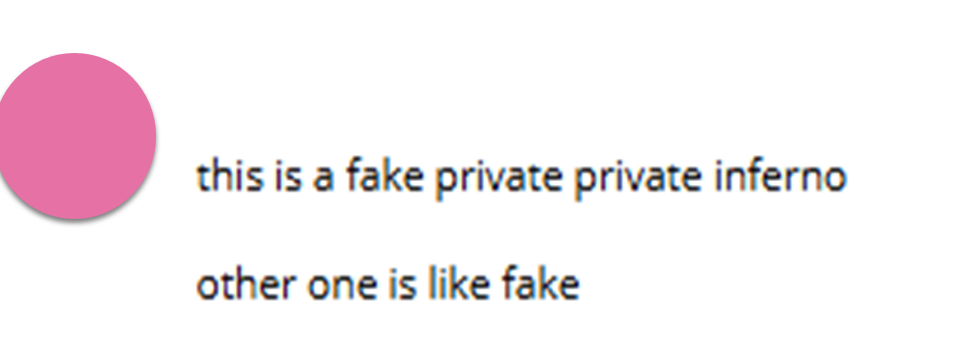
Analysis of the inferno chat, one of the core fake private private inferno channels, reveals clear operational guidelines and an explicit emphasis on generating high-quality sadistic and violent content. This inner circle determine the requirements of membership and reinforce the reality that advancement in 764 hinges on producing quality content. For example, one member of the chat explicitly discussed grooming a minor to kill her pet, however, the resulting product was "wack ass" and do not meet requirements to count as a point; highlighting the disturbing nature of actions demanded by the group.
Despite the emphasis on content generation for advancement, leadership explicitly distinguishes between content creation and genuine loyalty. As Trippy, a key leader within 764, articulated: "Content don’t equal loyalty" and elaborated, "when you keep a circle with guys you fully trust you can often pick apart the odd ones out." This highlights how loyalty remains highly valued yet rare, a crucial factor in maintaining the group's operational integrity.
The inferno chat logs also demonstrate calculated deception as a core operational security strategy. Leaders explicitly discuss creating fake or "dupe" inferno groups to mislead law enforcement and researchers. This layered deception underscores their strategic efforts to shield the true inner workings from outsiders, effectively complicating infiltration attempts.
Additionally, the chat highlights operational adaptability and strategic expansion. Leaders discuss adopting ISIS-inspired recruitment tactics by targeting vulnerable populations, such as Muslim minors, to bolster the group's influence and expand operational capabilities. These strategies demonstrate deliberate attempts to exploit vulnerabilities for strategic growth.
Within the inferno cell, stringent evaluation processes, continuous performance reviews, and a culture of accountability reinforce internal discipline. Leaders regularly reprimand members failing to meet standards or producing content outside of assigned activities, indicating a clearly defined operational hierarchy. This internal discipline is further reinforced by a cultivated culture of paranoia and mistrust, complicating infiltration attempts.
Insights from leader Trippy illustrate clear succession planning and operational continuity. Trippy explicitly stated, “Tell him I’m gonna be giving 764 to y’all for good before I go again,” specifying the transition of leadership to "Skin and Neo aka risky blasphemy." He emphasizes the collective, nested nature of the group by noting, "Since the group runs within a group," highlighting the importance of trusted leadership and their interpersonal bonds. Moreover, it is explicitly stated: "I don’t do anything without terror council permission," reinforcing the hierarchical and approval-driven decision-making structure.
The current documented structure of the 764 inferno group is:
- Founder: Ven, Brad
- Co-Owner: Trippy
- Admin: flar
- Members/Slaves: Skin, Risky (Neo aka risky blasphemy), S1N
Recent real-world incidents, such as the arrest of key inferno members like Neo, underscore the tangible threat posed by this network, illustrating its international reach and severity of actions. These developments affirm the critical role of operational security, hierarchical accountability, and genuine loyalty as central features of the 764 network's ongoing operational effectiveness.
B) MANIAC 6. CELL 4
In analyzing the leaked chat, we can gain some insight into the 764 network's command and control structure. It follows a hierarchical cell-based model designed for both operational security, as well as a reward and motivator for new recruits. The cell has clearly delineating roles and responsibilities. Each cell within 764 operates as a specialized unit, tasked with generating specific types of violent or extremist content (in this case extortion content), essential for gaining recognition and status within the broader Com Network.
The cell follow this hierarchy:
- Cell Owners: The top authority, responsible for oversight, strategic direction, and enforcement of standards.
- Council Members: Act as decision-makers concerning recruitment, promotions, and access to higher layers.
- Veterans: Members with proven loyalty and a track record of producing violent or extremist content.
- Recruits: New members tasked with generating violent or destructive content to progress within the ranks.
Recruits are explicitly informed that advancement within the network requires tangible content creation, notably violence-oriented acts documented through videos or images. A clear operational logic emerges: A) Actions = Membership**: Commitment is measured by willingness and ability to commit real-world violence. B) Content = Access: Documented acts function as currency for entry into more elite groups, referred to as "inferno cell."
This operational structure creates incentives for recruits to escalate violence progressively. Recruits in the chat are explicitly informed:
"after producing content you'll grow up the ranks, once you hit veteran you'll be invited to the inferno."
Specific content quotas guide recruits toward escalating severity:
- Grooming minors for self-harm or violent acts (e.g., carving "blood signs")
- Arson
- Brickings (throwing bricks at targets)
- Graffiti (noted explicitly to be creative to amplify propaganda impact)
Gut a cat 1/1 Entry.
Arson 1/1 Entry.
Brickings 3/3 Entry.
Graffiti 5/5 Entry (has to be creative)
An illustrative exchange highlights this incentive structure: When a recruit proposes grooming a minor female to produce self-harm content by carving "blood signs," the response from leadership implicitly supports such activities, underscoring that content is integral to rank advancement. In another instance a recruit stated that "ima kill a cat for u And make content with it Just for you", the cell owner responded "ifu kill a cat, u make it straight to inferno". In another exchange, recruits are explicitly told animal cruelty "won't stop," emphasizing its centrality to the group's culture and operational branding. The presence of animal abuse, especially animal crushing, is normalized, reflecting the group's sadistic undercurrents. Animal crushing and sadism towards animals is a behavioral red flag for 764 accounts; it is also one of the lowest and easiest transgressive barriers of entry a minor will carry out.
Not only do we see that there is a segregation between the criminal activity typology, but also in content type and the branding of the group. The chats further reveal operational discipline. A veteran was reprimanded for posting non-ext content. the veteran was bragging about a car he set on fire and recorded in order to gain access to the Inferno cell. He was informed by the cell owners that firebombing should be posted in the IRL cell not the ext cell, and it should be sent to the KNR server which is dedicated to offline criminal activities and "X" for hire services.
Content generation practices indicate deliberate segmentation within the Com Network. Although 764 and KNR publicly project distinct brand identities, chat archives, tell a different story. One where the same individuals in 764 are generating content for KNR and may even act as the service provider for the "X" for hire services that a recruit will complete to gain access to a layer of 764 closer to the core of the group.
The competitive structure of 764 seen in this cell serves multiple operational security purposes:
- It filters out "keyboard warriors," ensuring membership consists only of individuals proven capable of violence.
- It creates intense peer pressure and competition, driving members to perform increasingly extreme acts.
- The hierarchical vetting through documented violence enhances trust within cells, making infiltration difficult for law enforcement or outsiders (“comfeds” and “journos”).
- Cycles of retribution and revenge within cells create internal enforcement mechanisms, deterring potential informants or weak links.
In short, 764’s command and control structure strategically leverages violent acts for internal validation, recruitment, and operational security, blending a cult-like adherence to brutality with pragmatic criminal enterprise.
C) NLM x 764 TOPHET
Analysis of the Tophet cell chat highlights the strategic goals, operational discipline, and future ambitions of the 764 network leadership. Tophet's main objective is explicitly stated by leader Ven: "We’re all here for when I bring back NLM and have full ownership; I will gather members slowly, and we will be the new faces ov terror." This statement underscores strategic planning for long-term growth and the deliberate cultivation of a distinct, violent brand identity.
The Tophet chat further reinforces the centrality of content generation in their operational strategy, explicitly encouraging members to accumulate content proactively. Ven directs: "someone get niggas and ask them if they want to join NLM," emphasizing aggressive recruitment practices. These interactions highlight a deliberate strategy of member recruitment and retention, emphasizing quality and quantity of violent or extremist acts as the pathway to recognition and power within the group.
Tophet also showcases a clear distinction between superficial involvement and genuine trust and loyalty. Despite Ven’s explicit push for aggressive recruitment, internal trust remains the critical factor in defining genuine insiders from mere "clout-chasers." This nuanced approach is consistent with leadership warnings from Inferno chat, where Trippy emphasized: "Remember content don’t equal loyalty," cautioning against equating popularity or content creation with genuine commitment. The need for a trusted, tight-knit inner circle provides resilience unique to the 764 network, explicitly distinguishing it from less disciplined online extremist milieus.
Moreover, the Tophet chat confirms active preparations for the revival and restructuring of the NLM subgroup under Ven’s control, further indicating a structured, goal-oriented, and hierarchical operational approach that strategically combines recruitment, loyalty cultivation, and content generation as essential elements of their broader extremist campaign.
In examining account membership and rosters across these chats we can infer a few things
- Cross-Membership and Overlapping Cells:
Several users appear in multiple cells, suggesting a fluid but structured movement of individuals within the broader 764 network. Members participated across multiple cells, indicating cross-cell collaboration or promotion. - Deleted Accounts as Operational Security:
The significant presence of "Deleted Accounts" suggests deliberate operational security practices. Members frequently delete or change identities to evade law enforcement scrutiny, complicating tracking and infiltration attempts. - Long Recruitment and Vetting Periods:
A member explicitly stated it took "a year to join 764," indicating that the vetting process can be lengthy, highlighting the careful and selective nature of membership acceptance and progression. - Alias and Identity Management:
Several key figures use multiple aliases, as observed with "S1N" operating as "Ares 7.6.4," and Trippy, who maintains multiple roles and responsibilities across cells. This tactic allows leaders to compartmentalize and obfuscate their activities, complicating investigative tracking. - Inner Circle Resilience and Trust:
Analysis reveals a core inner circle explicitly identified by leadership as trusted individuals. This inner circle contributes to the group's resilience, providing stability and continuity even when prominent members like Trippy temporarily step away or transition leadership to trusted members. - Clear Hierarchical Differentiation:
There is an evident distinction in status between leaders, veterans, and recruits. Veterans and members of leadership (e.g., cell owners and council members) consistently appear across multiple chats, confirming their central role in decision-making, leadership succession, and operational oversight. Recruits have clearly defined responsibilities with measurable content quotas necessary for advancement. - Operational Discipline and Punishment:
Discipline within the cells is enforced strictly. Members are reprimanded when submitting content incorrectly or to the wrong channel (e.g., a veteran disciplined for posting an arson attack in an extortion-focused cell). This rigorous internal policing maintains operational standards and reinforces the group's control structure.
| User Name | Chat Files Present In |
|---|---|
| ven 764/NLM | NLM x 764 TOPHET, 764 Inferno, 764 Maniac 6 cell 4 |
| Deleted Account Blue (Decay) | NLM x 764 TOPHET, 764 Maniac 6 cell 4 |
| Deleted Account Orange (dYiNg) | NLM x 764 TOPHET |
| Deleted Account Teal (3SØ0/eso) | NLM x 764 TOPHET |
| Deleted Account Purple (previous owner of H3ll) | NLM x 764 TOPHET |
| kisara | NLM x 764 TOPHET |
| S1n (Ares 7.6.4) | NLM x 764 TOPHET |
| you’re safe with us | 764 Inferno, 764 Maniac 6 cell 4 |
| Trippy 🩸🐉 | 764 Inferno |
| koba | 764 Inferno |
| T3n | 764 Inferno |
| Ares 7.6.4 (S1n) | 764 Inferno |
| chloe | 764 Inferno |
| CRXXK (risky) | 764 Inferno |
| Blasphemy | 764 Inferno |
| CCCCC | 764 Inferno |
| Purple Deleted (N0XIDES) | 764 Inferno |
| Neo | 764 Inferno |
| ⛧REPENT⛧㇆꧵丩 | 764 Inferno |
| Akaoworckc | 764 Inferno |
| Blur | 764 Inferno |
| slitted | 764 Maniac 6 cell 4 |
| vail | 764 Maniac 6 cell 4 |
| L | 764 Maniac 6 cell 4 |
| weary764 | 764 Maniac 6 cell 4 |
| Data | 764 Maniac 6 cell 4 |
| ⁷⁶⁴ | 764 Maniac 6 cell 4 |
| Sinner | 764 Maniac 6 cell 4 |
| Fallen | 764 Maniac 6 cell 4 |
| Deleted Account Orange | 764 Maniac 6 cell 4 |
The provided roster table and chat insights demonstrate a highly structured, selective, and internally disciplined network. The group strategically combines careful vetting, strict hierarchical control, alias management, operational security through deleted accounts, and selective trust, all underpinning their operational resilience and effectiveness in carrying out violent extremism.
IV. Operational Security (OPSEC)
A) Anonymity and Identity Management
764 emphasizes anonymity extensively, relying on pseudonyms, aliases, and transient accounts as fundamental security measures. Leaders and participants regularly use multiple identities to compartmentalize their roles and activities. For example, the presence of users across multiple chats under different aliases or ghost accounts, confirms systematic identity rotation. This approach complicates external identification and infiltrations. Additionally, the frequent occurrence of deleted accounts—referenced repeatedly in chat logs—indicates intentional identity obfuscation, making tracking challenging.
B) Hierarchical and Nested Structure
The 764 network employs a strictly hierarchical, nested cell structure, compartmentalizing its activities and restricting the flow of sensitive information based on rank and proven trustworthiness. Advancement within this hierarchy depends heavily on the successful generation of explicit, violent, or exploitative content, which acts as both a test of commitment and a form of operational security. The lower an individual's rank, the more limited their access is to sensitive information, inner workings, and core decision-making processes. As members progress up the ranks—proving their loyalty and capability through increasingly severe actions—they gain deeper access and influence. This careful compartmentalization ensures that only thoroughly vetted individuals, who have demonstrated significant commitment through actionable violence and exploitative activities, can access critical or sensitive information.
Activities and content types are strictly assigned specific channels or servers. Members are reprimanded for posting misaligned content—such as posting arson content in an extortion-focused cell instead of the designated IRL cell. Consequently, infiltration by outsiders or law enforcement is substantially complicated, and may require different policy coverage or teams to mitigate the segregated threats, maintaining the network's operational integrity.
C) Explicit and Implicit Verification Protocols
Instructions for security procedures are embedded within regular communications to normalize rigorous verification methods. Chat logs reveal explicit procedures to confirm identities securely. For example, Trippy instructed others:
“When guys are verifying you should securely check it’s them.”
This illustrates operational discipline around identity verification, indicating systematic and pre-arranged security checks. Implicitly, conversations illustrate careful monitoring of member authenticity ("Did zuu text you to confirm to me that it is him"), which reinforces an ongoing self-policing mechanism within cells. Such protocols ensure that infiltration attempts are detected promptly.
D) Strategic Deception and Decoys
Leaders explicitly plan operational deception through the creation of fake or "dupe" inferno cells designed to misdirect law enforcement and researchers. Internal discussions regularly reference these decoy groups as deliberate traps to obscure the real inner workings of the core cells, complicating investigative efforts. Beyond cell-level deception, individuals within 764 strategically utilize stolen, borrowed, or compromised accounts, adding layers of obfuscation to their identities and operational roles. Chat archives reveal explicit instructions for identity verification protocols, reflecting constant vigilance against infiltration. The use of ghost accounts, multiple aliases, and periodic deletion of accounts serves as additional methods to evade detection. Collectively, these measures illustrate the group’s highly adaptive approach to operational security, leveraging deception at both collective and individual levels to safeguard core operations.
E) Cross-Cell Mobility and Resilience
Cross-membership of key individuals across multiple cells (such as "Ven," "Skin," "Neo," and "Trippy") provides operational resilience and facilitates continuity. If a cell is compromised, members easily transition to other cells, allowing operations to persist without major disruption. The trusted inner circle’s continuity is further reinforced through strong interpersonal bonds and clear succession plans. Leader Trippy explicitly indicates succession arrangements: "I’m gonna be giving 764 to y’all for good," demonstrating deliberate leadership transitions and group stability planning.
F) Loyalty versus Content Generation
Although advancement within 764 is explicitly dependent upon the production of violent content, leadership emphasizes that content generation alone does not ensure genuine loyalty. As leader Trippy succinctly warns, "Remember content don’t equal loyalty," clearly differentiating genuine trust from superficial clout-chasing. Loyalty within inner circles remains valued, rare, and crucial to operational integrity, highlighting the careful cultivation of trusted insiders.
Conclusion
The leaked archives from the 764 network illuminate a disturbingly effective extremist organizational model characterized by hierarchical control, systematic violence-based advancement, and rigorous operational security protocols. At its core, 764 leverages violent actions as both currency and verification of loyalty, meticulously blending criminal enterprises with ideological fervor. The emphasis on compartmentalization, strategic deception, and stringent internal discipline creates an environment highly resistant to external disruption and internal betrayal. Ultimately, the 764 network represents a modern hybrid threat, employing a calculated fusion of psychological manipulation, operational ruthlessness, and sophisticated communication strategies, making it both resilient and profoundly dangerous.