Spawnism Carving Pixels into Flesh: Cult Coding Children Into Self-Harm and Online Child Sexual Exploitation




Executive Summary
Spawnism is a fringe but growing self‑harm movement rooted in the Roblox horror game Forsaken. Although the game’s developers confirmed the cult is fictional, online actors repackaged the lore as doctrine: carving the spawn icon into one’s skin or making “sacrifices” in‑game will trigger a real‑life respawn. Minors on TikTok, Discord, Reddit, X/Twitter and private Roblox servers are the primary victims. Threat actors exploit the narrative to groom, obtain personal data, and push vulnerable youths toward self‑injury and suicide. The grassroots counter‑movement “Anti‑Spawnism” works to debunk the cult, report grooming hubs, and distribute crisis‑line information. It functions similarly to anti-extortion groups in the Com Network.
- Threat actors recruit primarily on Roblox, leveraging the “Trusted Connections” voice feature to bypass text filters, then migrate targets to Discord, Guilded, X and niche forums such as Skibidi Farms and Fella Farms. Subcultures that are targeted for possible victims focuses on minors already engaged in Forsaken fandoms, Warrior Cats role‑play, and similar communities. Vulnerable children displaying depression, self‑harm, or eating‑disorder content receive personalized invites.
- High-volume Trusted Connections plus voice chats with reduced filtering create a permissive environment for predation. Cross-platform groups provide recruitment, reinforcement, and migration to less visible spaces.
- Skibidi Farms, run by Klaask (links to No Lives Matter and 764), acted as the grooming gateway: forum posts steered minors to private Discord servers, where mandatory account verification on SF exposed their emails and IP addresses, information later used to intimidate and control them.
- Initiation rituals demand nude exposure, full‑body measurement, and the carving of the Spawn symbol while on camera. Captured material becomes blackmail to force further sexual acts and generates child sexual‑abuse files that circulate for clout. Continuous pressure escalates cutting, disordered eating, suicide attempts, and sometimes ideologically driven violence. Victims are coerced to recruit peers, amplifying reach.
- The ecosystem reuses Com‑Network manuals detailing extortion, CSAM trading, and operational security. Anti‑Spawnism groups add an adversarial dynamic that keeps the cult’s narrative active and can trigger retaliatory harm.
- Key Players: Klaask—administrator of Skibidi Farms, senior figure in No Lives Matter, linked to 764. Chezble—operational “prophet,” owner of Church of Spawnism servers. Support comes from Skibidi Farms staff and Com‑aligned extortionists who coach grooming scripts.
1 Background
1.1 Spawnism as Nihilistic Violent Extremism
A community of Forsaken fans that call themselves “Spawnists” will roleplay with each other in conversation as if they are members of the Spawn Cult from the game. This dynamic serves as a type of interactive, communal fanfiction, to develop creative stories beyond the original game. The roleplay started as a playful form of interactive fanfiction by users of the Roblox experience, but some of these groups have since been infiltrated by threat actors seeking to find victims for grooming towards violence and self-harm.
Many of the people who claim to worship the Spawn in these conversations likely have an understanding that this is role-play and creative fiction; however, there are some who seem to be earnest about having a real spiritual experience with the Spawn, which can be concerning to their friends and loved ones.
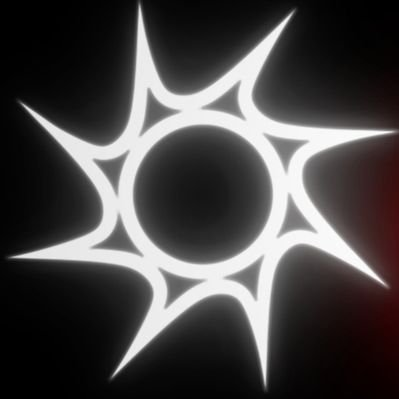
Those who claim to have a genuine connection to the Spawn describe the image of the spawn point as an imperfect representation of an abstract spiritual entity or concept, in a similar way that a person might use traditional religious iconography as inspiration for prayer or meditation. They push back at messages that they are "worshipping a PNG," as they see the image of the spawn point as being only a symbol.
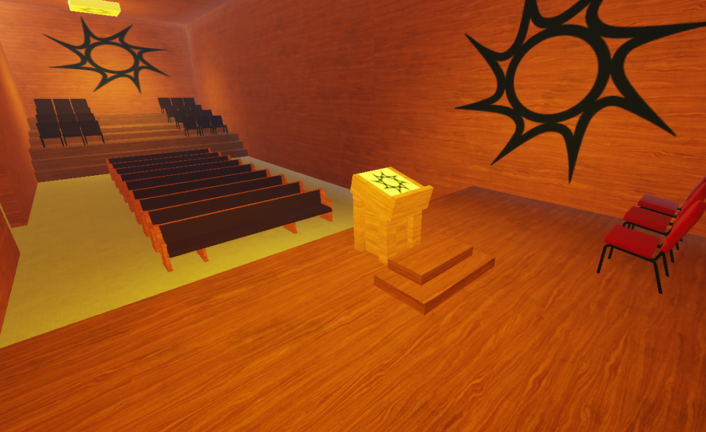
“The Spawn” is often discussed in a similar way to how many people would refer to God, with Spawnists sometimes adapting Bible verses in a way that signifies their new beliefs. Some Spawnism experiences on Roblox even include a space that replicates the interior of a Christian chapel with a pulpit, devotional banners, and rows of pew-like seating for parishioners. The Spawn is not always considered to be destructive. Some Spawnists mention how their concept of The Spawn encourages them to eat, drink, sleep, and do basic-self care in times when it otherwise feels challenging. Online abusers have infiltrated these communities and taken advantage of vulnerable people within the Spawnism fandom, and encouraged young people in self-destructive habits. A significant number of social media users have posted self-harm photos with claims that The Spawn encouraged them to cut themselves, showing off Spawn symbols carved into their skin. Some Spawnists have also suggested that 'The Spawn' has encouraged them to commit suicide, with a promise that there would be reincarnation and a literal second life or some kind of afterlife on the other side. Rumors have spread that several "Spawnists" have already killed themselves, although these claims are unconfirmed.
Because of the growing concern over people harming themselves in reference to Spawnism, Forsaken developer Hytok0 issued an official statement reminding people that the cult is fictional and that the Forsaken developers do not support self-harm.
1.2 Spawnism, the Tsuki Project, and Kali/Acc
Unlike harassment networks like UTTP (UTube Troll Police) or Com's structured and hierarchical sadism, Spawnism's emphasis on spirituality and self-betterment, simultaneously with post-irony and role-play draw from different elements of the internet's cultural DNA. Performative 'cult-like' movements with an in-lore emphasis on digital transcendentalism while inhabiting a grey area in participation are not new.
1.2.1 The Tsuki Project
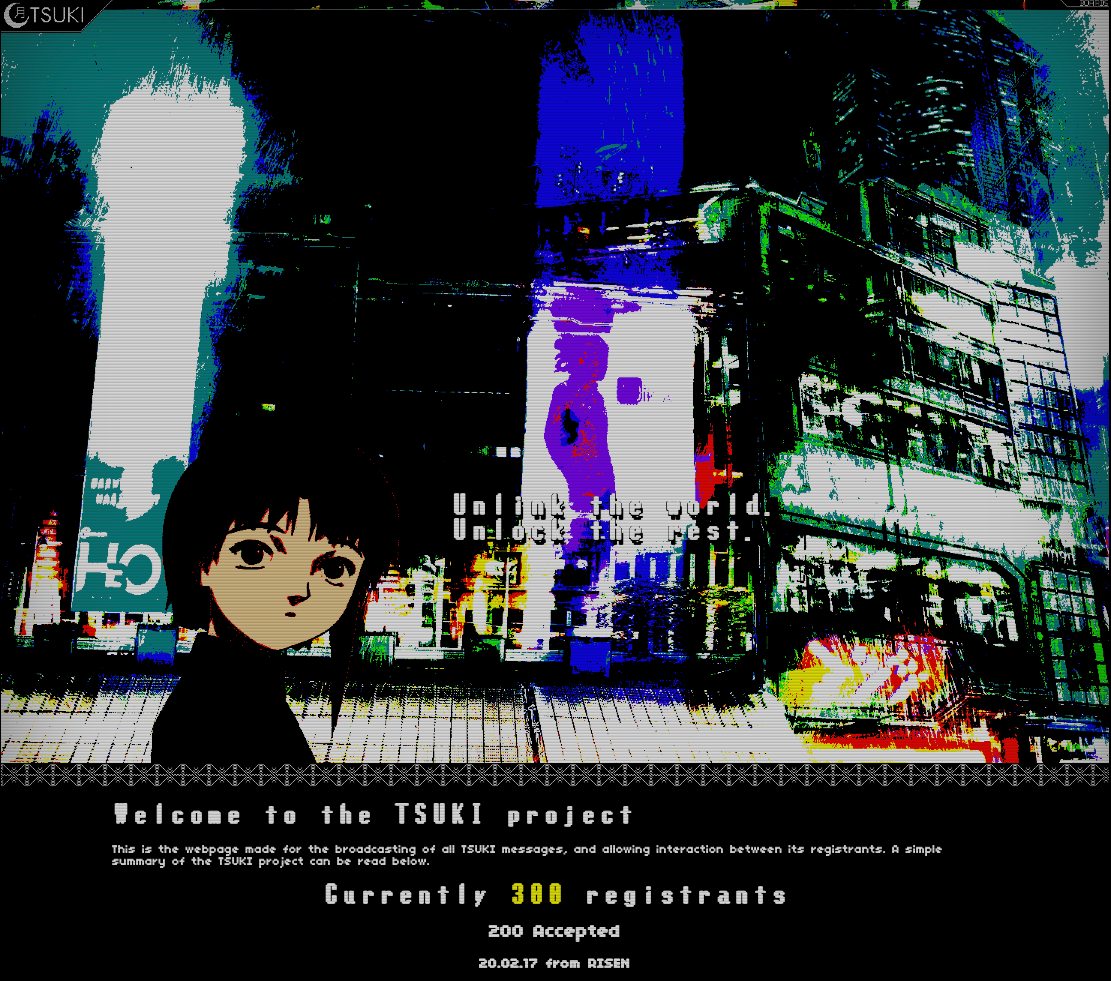
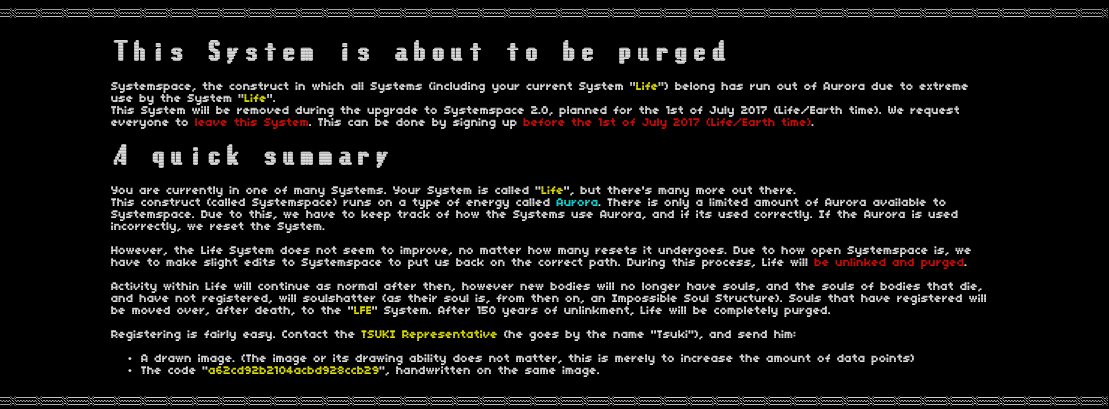
In 2017, a subculture emerged out of 4chan promising transportation to a cyber-paradise after the death of their physical body. Nearly 5000 people were recruited by a user known only as Tsuki, predominantly from 4chan. From there, they moved to Systemspace (the Tsuki Project forums), where they were told that should they die any time after July 1st 2017, they would be transported to LFE, a digital utopia of “massive sprawling cities” and beauty. Both old-age and suicide were considered acceptable deaths.
The Tsuki Project was referred to as an “anime suicide cult”, a “digital Heaven's Gate”, but also a Creepypasta, and an art project.
1.2.2 Kali/Acc
In 2019 the beginnings of a movement emerged out of a series of Discord servers that professed a syncretic blend of the cybernetic philosophies of para-academic blogging, Buddhist aesthetics, occultism, Esoteric Hitlerism, and inflammatory reactionary politics. The movement was called Kali Yuga Accelerationism, or Kali/Acc.
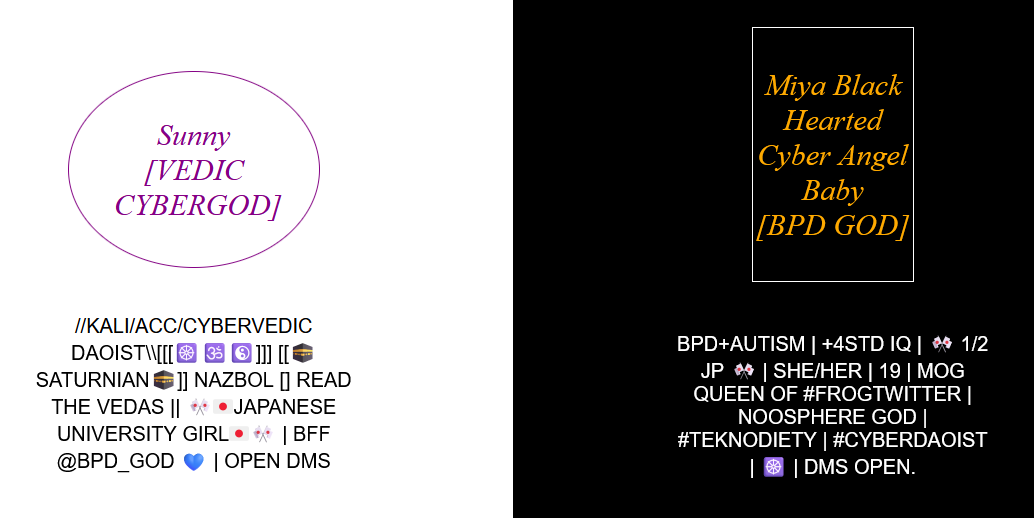
The two figureheads of this movement were 'Sunny (Vedic Cybergod)' and 'Miya Black Hearted Cyber Angel Baby (BPD GOD)' – two (at the time) anonymous accounts displaying a blistering array of disparate influences and signifiers, appealing to a wide range of extremely online communities. Much like Com, the founders and earliest participants came from 2010s 4chan, the area of Twitter known as “frogtwitter,” and the militant accelerationism skullmask movement. The aesthetics and high emphasis on occultism in Kali/Acc set the template for CoreCore and CuteCore movements that followed.
Lovebombing language, exaltation of self-betterment, mixed with messaging of severe body-policing, racial supremacy, and Evolean Traditionalism formed the topical foundations of Kali/Acc. This intense mix of influence, in/out grouping, and participation led to an active online subculture, with members free to take up the Kali/Acc mark in their username or bio–providing they could hit the criteria. Being able to navigate conversations about the nutrition of Ray Peat and prove your BMI, while holding your own memeing about the Accelerationist philosophies of Nick Land or talking about Savitri Devi earned you a seat at the cool kids' table.
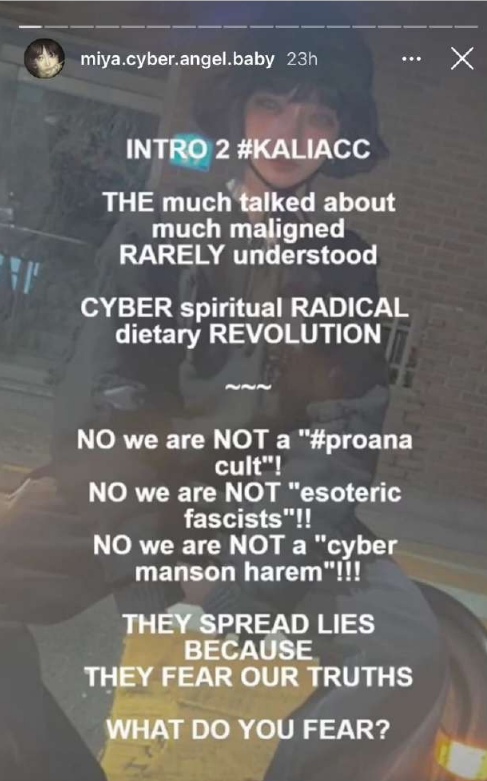
By 2022the leaders of Kali/Acc were mired in accusations of coercive control, abuse, encouragement and courting of eating disorders and mental illness. Several victims published screenshots and documentation across Instagram and Twitter showing that Miya and other members of the Kali/Acc Discord and Guilded servers as well as Twitter group chats were grooming young girls–manipulating them into sending nudes, self-harming, and starving themselves to achieve extremely low body-fat percentages.
Although the Tsuki Project and Kali/Acc may not have direct link to Spawnism, their structures for participation and behaviour, the performative grey area between sincerity and irony, and the extreme behaviours of their leaders all show through in Spawnism's online culture. The digital afterlife and Creepypasta allure of the Tsuki Project and the harder-edged cultic dynamics of Kali/Acc can both be seen in Spawnism.
However, while the Tsuki Project simply fizzled out over time and Kali/Acc eventually leveraged its place in the esoteric right-wing Twitter ecology and metastasized into the Remilia Corp and Milady crypto 'cults' by 2021, Spawnism brings a new dynamic to the mix that presents a greater risk.
Neither the Tsuki Project nor Kali/Acc had something to actively push against. The former had only a promise of a better life and the latter sought mostly to position itself as a post-liberal counter-culture. Spawnism, on the other hand, has the dynamic of adversarialism present in UTTP and Com that may present a risk to perpetuating the movement. Much like the Anti-UTTP, and the Anti-Extortion vs Extortion Com dynamic, Anti-Spawnism groups have formed in reaction to the movement. By providing a 'villain' to Spawnism, the Anti-Spawnism movement may prolong Spawnism's online lifespan while also providing justification for an escalation in behaviors.
2 Where did Spawnism come from? A Roblox game...and No Lives Matter
2.1 What is the Forsaken game on Roblox?
Forsaken (previously known as Damnation) is a Roblox experience released on December 25, 2024 by developers Hytok0 and Basil. It’s a still-evolving game with varied characters and storylines.
The game reads as highly satirical and whimsical, paying tribute to Roblox in-jokes, popular Roblox admin and dev team members, creepypasta lore, urban legends, and classic horror films.
Players can choose the experience of acting as the character of either a killer or a survivor. Basic characters are available right away, while additional characters can be unlocked for a set number of points. Each character has its own combination of skills, outfits, and weapons. A variety of play styles among the characters offer many different ways to enjoy the game.
![Artwork by [NOLI🎭] Forsaken](https://storage.ghost.io/c/8f/b7/8fb7d98f-6ee3-409a-b045-b47cf9f61791/content/images/2025/08/Pasted-image-20250722230454.png)
The game serves as a type of interactive storytelling device, with different plot lines depending on the player’s choices, like a “choose-your-own adventure” narrative. It borrows a traditional role-playing game (RPG) framework and mechanics, including the use of hit points, skills, character classes, quests, stats, inventories, and maps. There are aspects of the gameplay that are collaborative, as well as player vs. player (PVP) functions. The gameplay is mainly focused on survival, stealth, and fighting, but many fans of the game have found the snippets of backstory to be highly intriguing.
Within the game environment of Forsaken, narratives and characters are relatively simple, with a lot of room for individual interpretation and storytelling. Many players are compelled to create their own fan art and fan fiction about how they imagine the characters would interact. The stories that are officially “canon” are still in the process of being written by the developers on an ongoing basis. The developers often interact with fans of the game, adding to the character backstories, taking questions, and providing additional character personality details on social media platforms such as Discord and X.com (formerly Twitter).
2.1.1 Game Plot
The basic plot of the game involves a formless malevolent entity known as “The Spectre” who seeks out individual characters within the world of Roblox and transports them into the realm of Forsaken, trapping them and forcing them to fight each other. The Spectre is described as “incomprehensible” and is said to choose its victims by preying on those who are experiencing strong negative emotions such as guilt or grief, or who have experienced tragic or traumatic life circumstances.
When a player clicks off of the game tab, The Spectre sends messages trying to entice them back into the game, such as:
"you belong to me now."
"you can't escape me."
"leaving is not an option."
"you brought this upon yourself."
Although The Spectre was intended to be only a fictional horror entity, this type of messaging is echoed in the real life Spawnism chats from groomers to their victims. Similarly, groomers within these chats target victims of trauma, echoing the victim selection of The Spectre within the game.
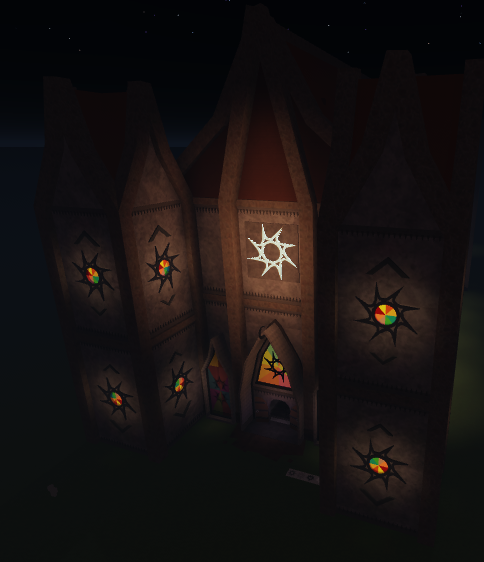
The concept of the “Spawn Cult” is a subplot within the game. The Forsaken characters of Two Time and Azure have a backstory of following the religion of the Spawn Cult, and worshiping “The Spawn,” which is represented as an image of the in-game spawn point at which a character resurrects after dying in the game.
Two Time is described in-game as “A fragile cultist that holds a terrible secret. Bearing nothing other than a sleek dagger and a manic smile, they're able to earn a second life through risk and sacrifice.” Two Time and Azure were said to be best friends and partners until Two Time became increasingly dogmatic about the Spawn Cult and ultimately killed Azure as a sacrifice to The Spawn. Azure was resurrected with a new, tentacled body, and Two Time’s body was also transformed to grow wings and a tail that were formed from their own skeleton. Azure became a killer upon resurrection, and the relationship with Two Time was forever damaged.
Even within the game, resurrection by way of respawning is said to be “illegitimate,” and a function of psychological trickery manifested by The Spectre.
2.2 Connection to Skibidi Farms and No Lives Matter
According to the evidence online we have reviewed, we assess that Spawnism has a link to the Com Network, but not one most would assume. Our findings would appear to indicate that the current leader of No Lives Matter, Klaask (who also is the Admin of Skibidi Farms, aka SF), along with one of his SF admins, are behind the creation of Spawnism 'cults'. And that they are who have been enabling a Roblox and Discord user known as "Chezble" in the creation of the "Spawnist Cult", and have been coaching him while helping him extort and groom victims. Through his "Church of Spawnism" Discord servers, Chezble has successfully harmed dozens of minors who have all been recruited either through Roblox or the Roblox community on X and Discord. The primary game they are using to find victims is Forsaken and Chezble has been one of the primary drivers of the harm and grooming focused aspects of Spawnism.
For Parents it is not only Roblox you need to concern yourself with, Chezble has also been recruiting from other Discord fandom servers targeting minors involved in Warrior Cats RPG servers, Fate of Four, Felidasia, The Celestial Divide, Last of the Light, Dawn of the Clans, Winds of Ruin, Abyssaline, and Dellight Requiem. The goal is to groom and recruit them as victims.
The web forum Skibidi Farms was a principal site for Spawnism during its emergence as a tool for grooming children into acts of self-harm. Administered by an individual using the screen name Klaask–who has associations with Com exploitation groups like No Lives Matter and 764–the Spawnism threads would often direct readers to Discord servers where abuse could take place. Some Spawnism Discord servers would also direct prospective members to Skibidi Farms to set up accounts for server verification in order to gain access to their main Discord channels or servers. Upon confirming their SF username, they would be redirected to another Discord server. This is likely a tactic to gather information on potential victims because the administrators and moderators of SF had access to user's IP addresses and registration information such as the email address they used to register with. An email address can be leveraged to find real names, other user names, and accounts on other platforms. IP Addresses can reveal information about the country and state in which they reside. This information can be weaponized to make victims fearful and compliant.
Near the end of July 2025, SF abruptly went offline. A message posted to the site claimed they were suffering from server problems with their backend host. Shortly after, another web forum, Fella Farms, cropped up to fill the void. While less extensive than the original Spawnism thread, Fella Farms is now used by Chezble to post new links to Spawnism Discord servers.
Chezble’s 718 “Trusted Connections” on Roblox materially expand his capacity to reach and influence minors. Roblox’s age-based “Trusted Connections” unlocks Party Voice and chat without filters for users marked 13+, and for age-checked 18+ users with other age-checked 18+ connections. “Trusted Connections” are an opt-in, two-way subset of a user’s network that the platform frames as people you “know and trust.” At the scale seen here, that trust premise breaks down. The sheer volume creates many parallel, less-moderated communication paths that lower friction for grooming, coercion, and other abuse.
Functionally, more “trusted” ties mean more rooms, calls, and chats where automated text filtering is reduced or absent and voice is available. This weakens platform-level safeguards that often interrupt or flag predatory scripts in open text chat. It also complicates moderation, because harmful content can migrate into semi-private, relationship-gated spaces that are harder to detect in real time.
Open-source indicators we have observed suggest additional lines of inquiry. The Spawnism roleplay community has been around since at least March of 2025, however, Chezble only became a persona in the space approximately three months ago. Separately, a Spawnism group of roughly 150 members on Guilded appears active and is owned by an individual using the name “Owen.” The owner’s background is not yet established. The cross-platform footprint and group size point to organized social infrastructure that can funnel targets between platforms and into higher-risk spaces.
The operating method mirrors how threat actors from the Com Network piggyback on existing interests. Predators do not need to invent a new belief system. They exploit normal youth behaviors like role-play, LARPing, and metaphysical curiosity, then steer them toward desired outcomes such as self-harm, zoosadism, or suicide. LARPing and ARG-style play are common and not inherently harmful. The harm arises when peers and threat actors use these frames to desensitize, isolate, and control victims.
Manuals and “how-to” guides act as accelerants. Com-linked playbooks provide tactics, techniques and procedures on how to extort, groom victims, obtain and trade CSAM, build and hide on onion services, use encryption, and plan or execute violence, including weapon and targeting advice. The TTPs from these Com Network manifestos are present in this community. Chezble uses a similar step-by-step script, when approaching victims on Roblox, Discord and X. Some youths do not participate in the ritual, yet Chezbel selects victims who are isolated, vulnerable and have been banned from other Spawnist communities offering them a home in his servers.
2.3 Klaask
Klaask is the moniker used by an individual who has been utilizing Spawnism to push others into committing acts of self-harm and degradation. Klaask and their ilk are well-practiced in manipulating vulnerable youth into committing these acts and Spawnism has provided a new stream of victims to abuse.
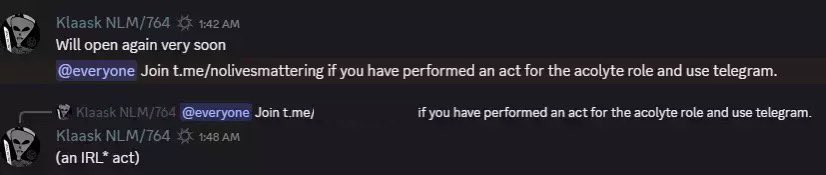
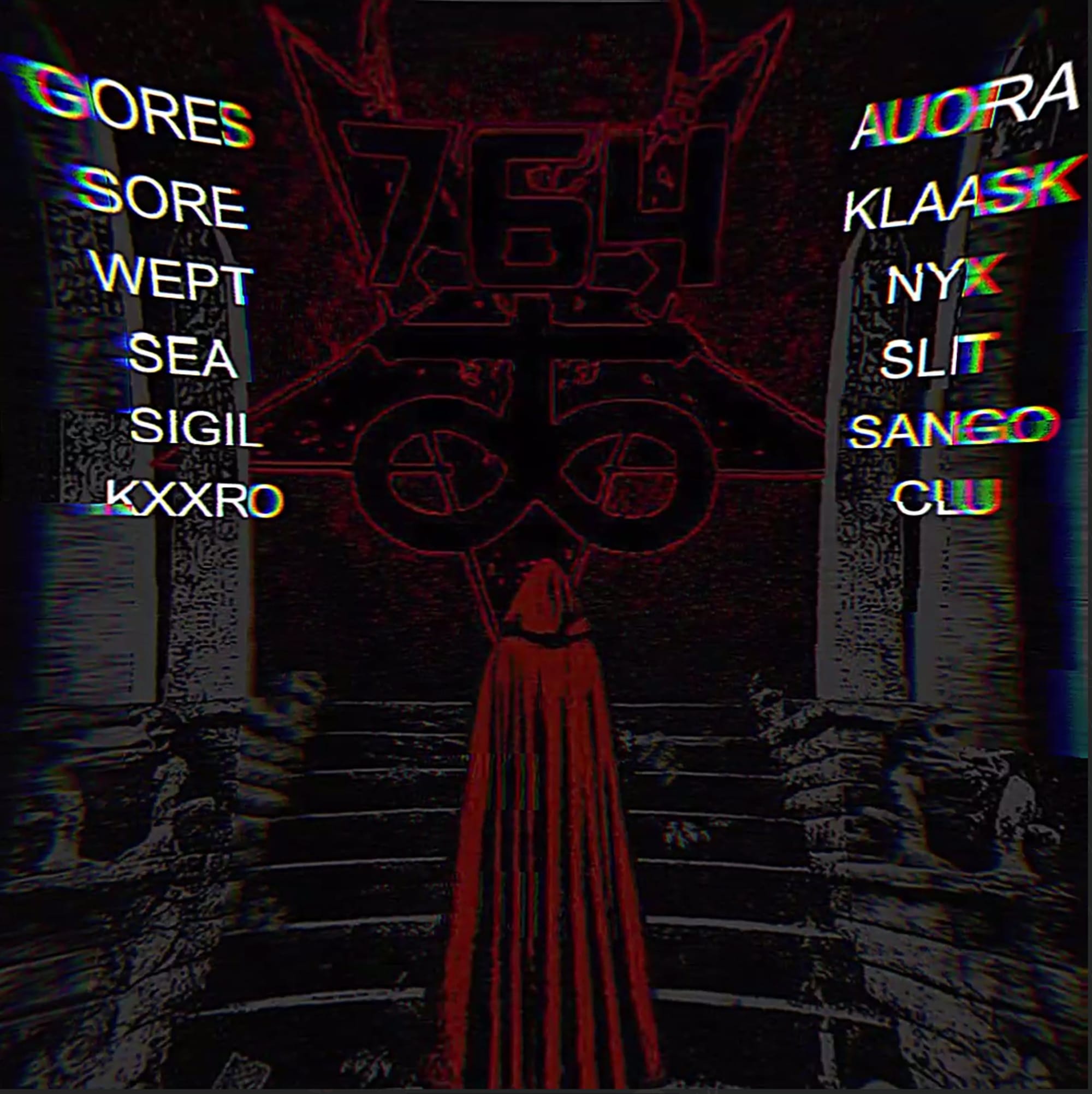
Currently the OS (owner) of No Lives Matter aka NLM, they have been an admin and co-owner of the web forum Skibidi Farms since Spring 2025 where they were previously a moderator. A recent roster put out by the current iteration of 764 also included Klaask as a member.
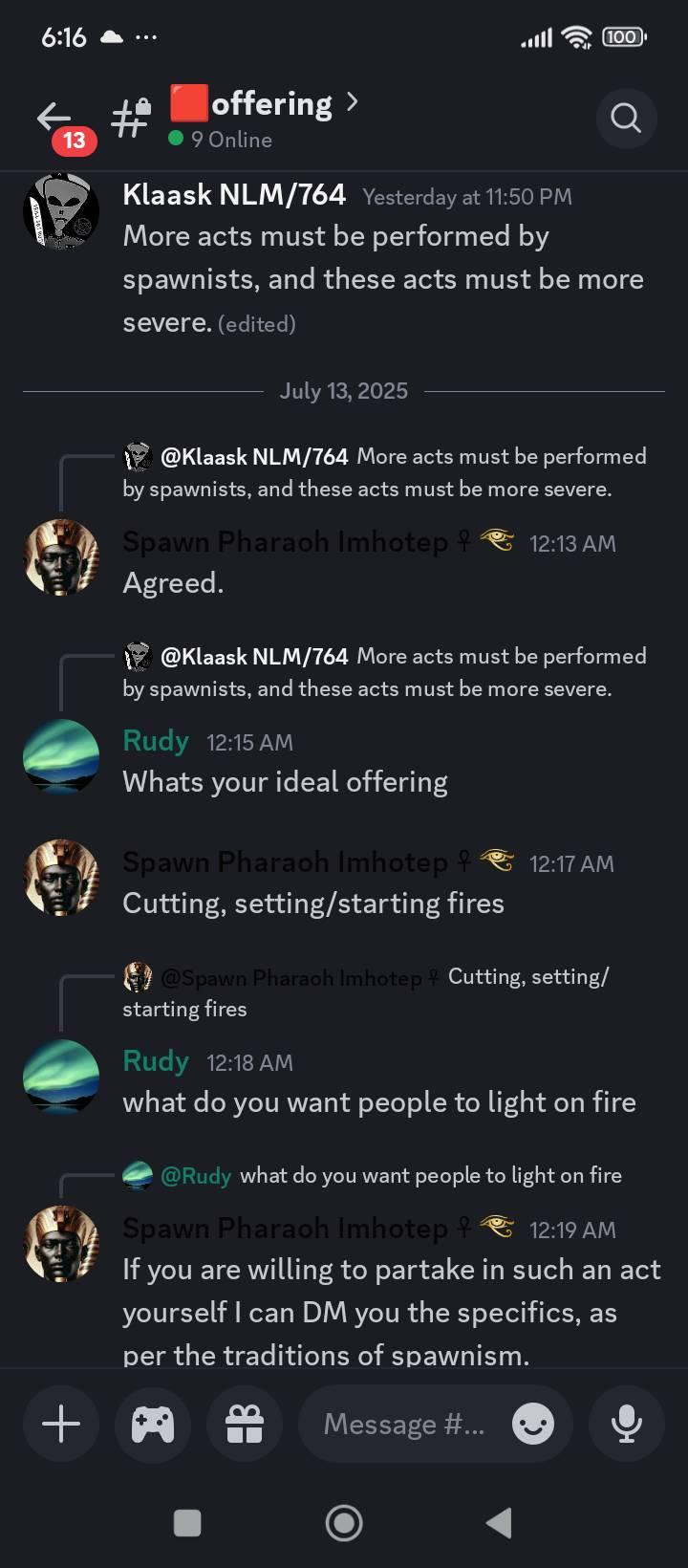
Through the targeting of at risk youth and individuals, Spawnism provides Klaask a direct line into the lives and homes of online and often isolated young people. For the victims, Spawnism is an outlet for individuals to direct their ideation of self harm and suicide. On the social media platform X, numerous images of individuals–some self-identifying as young as 13–are displaying images of self-harm and attributing Spawnism as an inciting or premising factor.
Klaask has refined his method of attracting victims, including posting across his various accounts hashtags and signifiers related to self-harm, cutting, Forsaken, and Roblox, as well as reposting self-harm content produced by others. Advertising Spawnism themed Discord servers as "child-friendly," once inside those willing were instructed to take part in a series of increasingly degrading rituals.
3 Ritual
3.1 Spawn Must Measure their Bodies
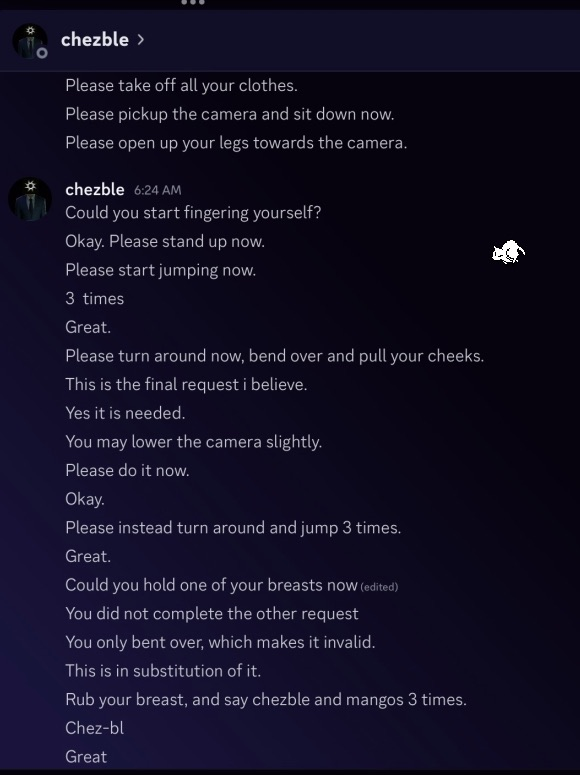
Chezble approaches victims and tells them to get on camera. The first part of the ritual is that the Spawn must measure their bodies to "recognize them when the time to send you to your second life comes." Chezble asks the victims to get fully undressed and uses different approaches to get them to face the camera nude and expose themselves: "spin around", "turn around", "dance", and "jump up and down" are all examples. He may tell them to touch themselves or play with their genitalia while saying "chezble and mangos" multiple times, or he may tell them to lie on the bed.
The objective is to exert power over the victim by having them get naked, while also providing an avenue for Chezble to collect images or videos of the victim in the nude, which can be used for extortion and blackmail at a later date.
According to chat records, Chezble uses social engineering and manipulation to get the victims to acquiesce. He plays into the lore of the game and the "belief" system to convince victims "a believer of spawn would not be shy to show their face to the prophet of spawnism". He describes himself as the "middle man between the spawn lords and the followers of the spawn." If the victims are anxious or stressed he will play nice and attempt to calm them down. However, in these moments he will use the opportunity to ask personal questions about the victim's location, interests, and family. These items can be used at a later time to doxx them.
3.2 Make a Sacrifice to the Spawn
The second part of the ritual, Chezble requests a sacrifice from the victim, this could be either burning themselves on camera, or using a bladed object to self-harm and carve the spawn symbol into their skin while on camera. If a victim is reticent, Chezbel inform them that he does not wish to hurt them, but protect them playing into the lore from the Forsaken game.
If a victim blocks Chezble or refuses to participate in self-harming he threatens them and their families with violence "do you want me to send some bad people to your house?" or threatens to leak the images and videos collected in the first part of the ritual.
It is important to note that there are two simultaneous Spawnist communities: Those LARPing Spawnism as part of a fandom and the and the communities run by predators, of which there appear to have been at least 3 seemingly distinct ones. To participants in these predator-run communities it appears that each community has its own leader or 'prophet': Chezble, Klaask, and a third or fourth actor.
These two communities are feuding with each other as the LARPing community have banded together to protect themselves from Chezble and his ilk, and seek to warn and protect those who have fallen into his grasp. However, Chezble has weaponized those who seek to white knight and protect the youngest members from being victimized, and coerces the protectors to self-harm in order to protect others from being victimized.
The tactics, techniques, and procedures used by Chezble in this instance are no different than the ones we have observed by perpetrators in the Com Network extortion community. This comes to no surprise considering the prominent role of Klaask (current leader of No Lives Matter) and admin of Skibidi Farms.
4 Recruitment and Harm
The largest Spawnism experiences on Roblox have received between 12,000+ and 72,000+ visits to their servers in the past 2 months alone. These largest experiences have either direct connections to Chezble or to others affiliated with him on Roblox. The sheer scale of the number of visitors to these experiences means that there are tens of thousands of potential victims to recruit.
4.1 Self-Harm
Self‑harm remains the central and simplest form of harm and clout of these communities. For many, cutting or burning themselves functions as a short‑term coping tool for overwhelming feelings generated by body dissatisfaction, perfectionism, and other pressures. These acts often form part of a broader clinical picture that includes anxiety, depression, substance misuse, and disordered eating. The behaviour temporarily blunts shame or hopelessness tied to perceived failures to meet internalized standards of appearance, conduct, or performance. These are all emotions and states of mind that are sought after by Chezble and other perpetrators in Spawnism.
Online exposure to self-harm multiplies the risk, and within the context of self-harm as a form of initiation ritual to a group one is seeking access to for acceptance and peers, there is a normalization of self‑injury (with other members having done the ritual) which lowers the threshold for imitation, especially among at risk adolescents already managing comorbid conditions.
Visibility of damage becomes not only currency for the perpetrator, but the mark of the Spawn carved in a victim's flesh is a sign of membership that is difficult to fake. The violence is camouflaged as access to a community and acceptance, which hides an economy that converts psychological suffering into clout.
4.2 Extortion and Sextortion
Blackmail underpins the main narrative and techniques used by Chezble. Using conversations with initiates to Spawnism during the ritual, Chezble will doxx victims, then threaten the public release of blackmail collected. Minors are coerced into sexual acts on camera; the material becomes leverage for further abuse, and the resulting files circulate as a prestige token inside the group. Victims find themselves trapped: fear of humiliation or harm keeps them silent, and their dependence on their abuser often grows stronger than any trust in family, friends, clinicians, or police. The cycle sustains itself because the content doubles as social capital, rewarding perpetrators with status while traumatizing victims.
4.3 Online Child Sexual Exploitation
Child sexual exploitation sits at the heart of the harm these communities cause. Very young users are pressed into providing sexual images or video that are then traded inside the group as markers of seniority. Recognition goes to those who can obtain or distribute the most graphic material, making abuse systemic rather than occasional. Threats, grooming tactics, and psychological pressure strip victims of choice. Shock value raises the seller’s social rank, while the children endure repeated trauma. The networks thrive on this currency of suffering, reinforcing a closed economy of exploitation and harm.
4.4 Intersection with online Dissociative Identity Disorder (DID) subcultures
Some social media users have been making accounts for Forsaken characters while claiming that the Roblox characters from the game inhabit their bodies in real life as “introjects” or “fictives” within a system of alternate personalities. These terms have their roots in the Dissociative Identity Disorder (DID) community, particularly within the online subculture surrounding this community, which spans a variety of social media platforms such as YouTube, Tumblr, TikTok, Reddit, Discord, and Twitter (X).
DID is a controversial diagnosis that has historically been considered by psychologists to be extremely rare, and a coping response to extreme psychological trauma. However, in some online subcultures, DID is frequently self-diagnosed and embraced as a form of self-expression.
The online subculture of DID has been growing in recent years. Psychologists have expressed concern that DID self-diagnosis could be a form of “mass sociogenic illness” with elements of contagion, as social media users encourage each other to embrace further splintering of their personalities.
Among social media users that consider the Forsaken characters to be fictives in their systems of personalities, Two Time and Azure are popular choices, and as a result, a number of people who identify as having Forsaken introjects in their system have been interacting with the online Spawnism community.
Conclusion
Spawnism exposes how online fandom can become a conduit for organized harm and violence when extremist actors inject ritual, fear, and reward structures. What began as a fictional respawn mechanic now drives real self‑harm and child sexual exploitation, packaged as spiritual ascension. Klaask, Chezble, and their Com‑aligned network exploit game aesthetics, platform gaps, and adolescent vulnerability to grow a closed economy built on suffering. The blend of adversarial storytelling and blackmail scripts makes the network resilient. Each takedown without follow‑up victim care and community education risks fueling the mythology.
Spawnism will not be the last fusion of gaming culture and violent extremism. Lessons learned here (about cross‑platform coordination, adversarial narratives, and harm monetization) should inform future countermeasures against similar hybrids that weaponize digital creativity against children. Of note, is the level of social engineering by leadership of No Lives Matter. It is no longer enough to extort victims themselves, but now they facilitate the formation of new 'cults' to harm a larger count of victims.