Beyond the Headlines: Arrest Data and Drivers of Nihilistic Violent Extremism in the Com Network


In his opening statement to the Senate Committee on the Judiciary, the head of the FBI made reference to 764 (a group from the Com Network) and Nihilistic Violent Extremism. There has been a fair amount of misunderstanding about what the Com Network is, as well as a misuse of the term “Nihilistic Violent Extremism,” which has become a catch-all in the media and popular culture to describe a complex and ever-evolving ecosystem.
For the past three and a half years, I have been researching the Com Network using a digital ethnographic approach, whereby I embed myself in the ecosystem and observe the behavior of community members, reading primary material they have produced and analyzing their multimedia. Furthermore, over the past few weeks, I have built a dataset of all publicly available arrests linked to the Com. To accomplish this, I have collected all the court records and news stories available globally to quantitatively demonstrate the breadth and depth of the threat. There are 194 Com Network arrests in 29 different countries between 2020 and 2025. I have also used court records, investigative reporting, and social media data to begin developing a framework to determine the risks, threats, and pathways of those who have been arrested for crimes committed as members of the Com Network.
This has been a complex endeavor and only represents an incomplete tip of the proverbial iceberg. Most of the perpetrators and victims are minors; therefore, the cases are sealed or unavailable to the public. Further, access to court records outside of the United States is difficult to obtain, which not only limits the information that can be gathered but also biases the results of my research to a certain extent. In training law enforcement and prevention practitioners in six different countries, I have gained additional insight from their own investigations and practices that has informed my research. Nonetheless, today’s post will be an opportunity to redefine terms and present some preliminary findings from my maturing research.
Terminology
Nihilistic Violent Extremism
The first thing that needs to be done is clarify what we are talking about in terms of threats, in particular what is meant by the term Nihilistic Violent Extremism (NVE) and what it represents. It is important to highlight that NVE does not equal “the Com Network” or “764,” that is a misuse of the term. Nor is it a replacement for “salad bar extremism.” Nihilistic Violent Extremists have carried out real world attacks (or attempted attacks) in Australia (Jordan Patten), Europe (Arda Küçükyetim and his alleged accomplice, “Hansen”), and the United States, in Wisconsin (Natalie Rupnow), in Tennessee (Solomon Henderson) and Minneapolis (Robin Westman) to name a few. Individuals often coordinate online to watch as members livestream or post about their attacks.
NVE is meant to describe the worldview and motivations of a specific type of threat and/or threat actors. The definition of NVE that I have developed differs from the one used by the FBI, as I have taken a global approach to researching the threat:
Nihilistic Violent Extremists are those on the fringe actively encouraging, promoting, glorifying, or engaging in serious acts of violence for the sake of violence and chaos in and of itself, the consequences of which have no clear end state.
At the core of the NVE threat environment is a deep-seated misanthropy: a hatred of humanity, human nature, and behaviour that fuels a desire not just to disrupt, but to destroy. This is coupled with the glorification of extreme and sadistic violence, where acts of brutality are not only celebrated but encouraged as a means of achieving chaos. The objective is not revolution or reform, but collapse without reconstruction; it is a tearing down of societal structures with no vision for what should follow.
Ideology is not absent within the nihilistic violent extremist milieu. However, it typically functions as a secondary or even tertiary factor, with its role largely limited to providing superficial justification for behaviours primarily motivated by grievance and the pursuit of status within NVE ecosystems. Extremist rhetoric is often adopted after individuals have already entered these spaces, rather than serving as the initial driver of involvement. In this context, ideology operates more as a post hoc rationalization (employed to legitimize efforts to gain recognition or to frame personal grievances as justified) than as a foundational motivator. This dynamic underscores why counter-ideological interventions alone are insufficient as prevention strategies: ideology is not the core problem but rather a convenient narrative backdrop against which members articulate and validate their primary motivations.
The Edgesphere
Moving on from the worldview, can we define the cultural ecosystem of NVE actors? Those of us who have been researching the NVE threat space for a few years now have come to call this ecosystem the “edgesphere.”
The edgesphere is composed of several continuously shifting and overlapping internet subcultures that emerged on the fringe of the most extreme communities of chronically online youths, which began forming and evolving between 2018 and 2020.
This subculture is defined by the cultivation of intentionally transgressive online personas and the formation of digital communities that engage in behaviours that range from disruptive to outright harmful. These behaviours lead community members to participate in a spectrum of activities, including but not limited to: coordinated online harassment, swatting, doxxing, online child sexual exploitation, sextortion, extortion, coerced suicides, animal crushing, zoosadism, and real-world violence.
The edgesphere includes an ever-changing subset of ecosystems, subcultures, and fandoms that include, amongst others: the soysphere (Soyjak Party), r/drama, foodists, UTTP, Clay Party, Skibbidi Farms, Hutucord, Report Gods, the Com Network, C-Grade, true crime communities, gore networks, Larpercore, Watch People Die, extreme furry communities, and some incel spaces.
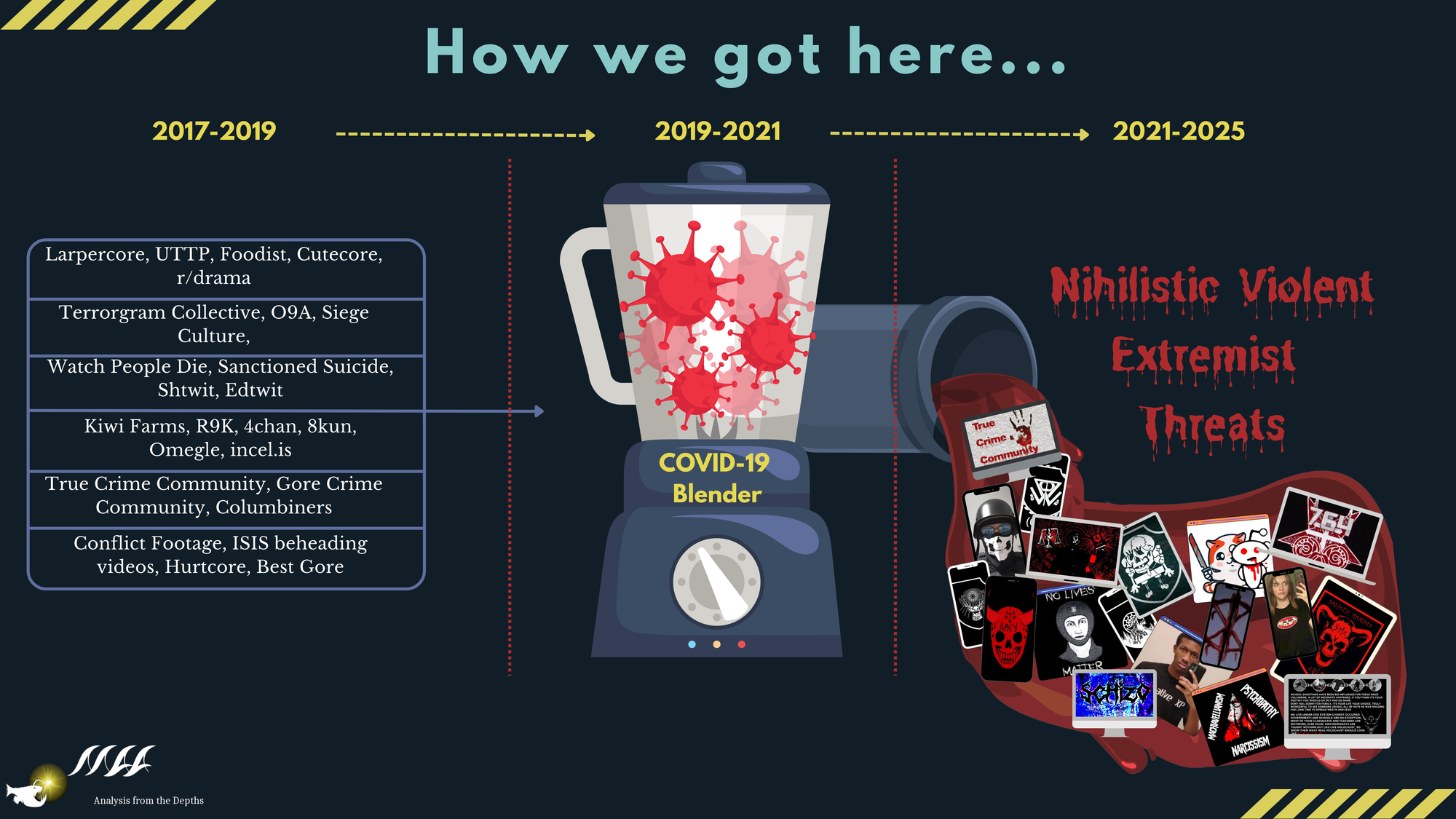
So how did we get to the threat of Nihilistic Violent Extremism? I call it the “COVID-19 Blender.” Between 2017 and 2019, and accelerating during the COVID-19 pandemic (2020–2022), extremist ideologies, tactics, and digital subcultures of the edgesphere converged in ways that produced what can be described as a “nihilistic blender” of harms and threats. This convergence combined misanthropy, the glorification of violence, and the intentional erosion of social norms, generating a hybrid threat environment inhabited by terminally online youths that resists conventional classification. This phenomenon is what I have been defining as Nihilistic Violent Extremism. The confusion seen in the media and from outside observers is due to the hybridization process: we can recognize pieces of different threats we have familiarized ourselves with, but the whole is something entirely new.
The Com Network
Over the past year, there has been more public awareness about the threat of the Com Network, with high-profile arrests of perpetrators from the network. This, however, has led to incorrect reporting, where in the media NVE is used interchangeably with “the Com” or “764” (the more infamous group in the Com Network). However, all of these things are different. The Com is one of the networks that makes up the edgesphere. The Com is not a homogeneous community; rather, it is a memeplex of digital criminal networks overlapping with gaming subculture. Furthermore, as Joseph Cox and Brian Krebs noted in past reporting, the Com has existed for a while now. The roots of the Com are what Brian Krebs described as a “cybercriminal social network.” It was in 2018 that the Com began hybridizing and expanding beyond its origins in cybercrime, with the introduction of Greggy Cult, CVLT, and 764 into the Com ecosystem.
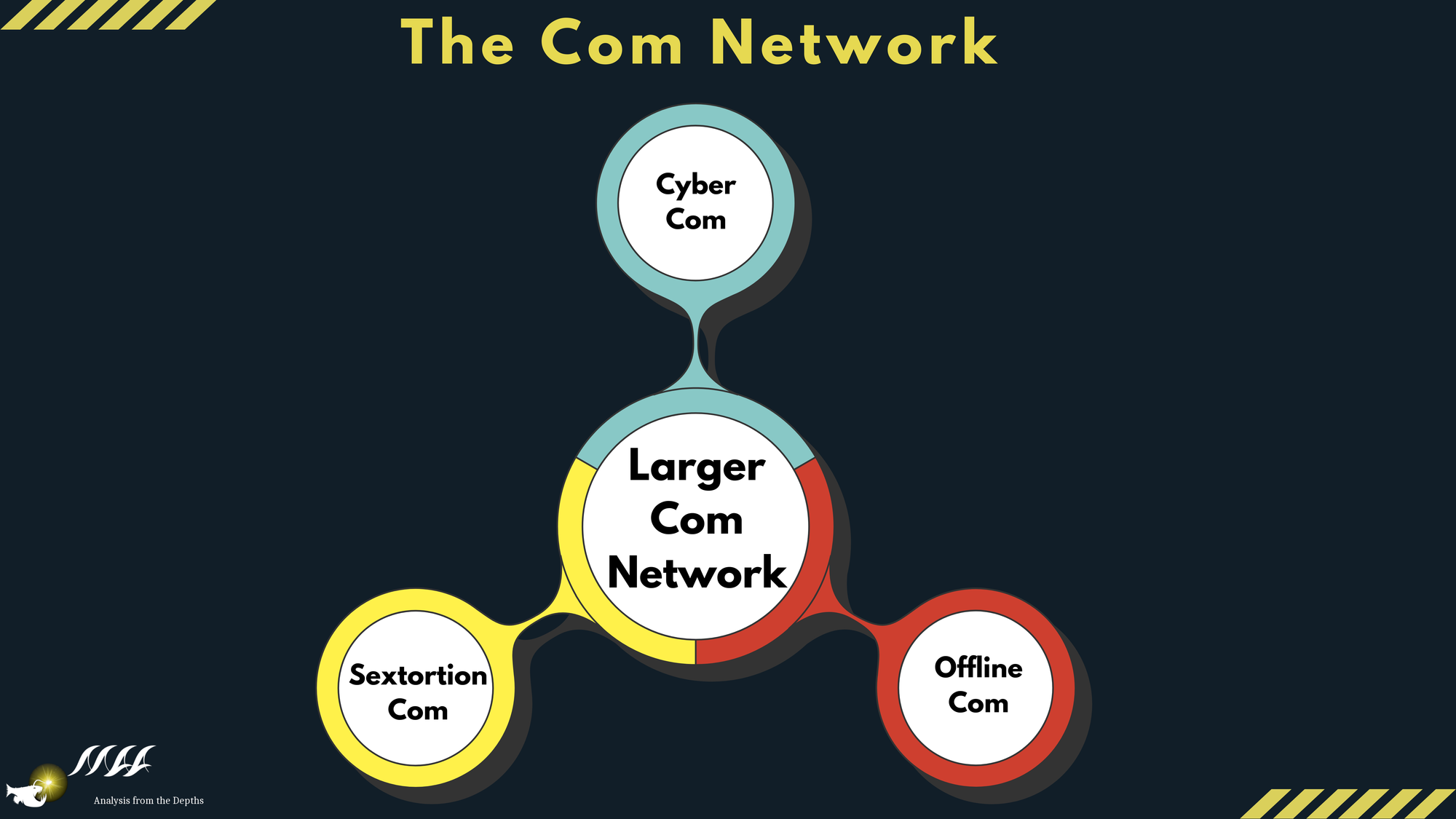
The current manifestation of the Com Network is an immense international online network of individuals that engages in or advocates for a broad range of criminal activity, including real-world violence. From a threat perspective, the Com can be segmented into three pillars of criminality.
- Cyber Com: members participate in cybercriminal activities.
- (S)extortion Com: members participate in extortion/sextortion, coerced self-harm or suicide, and animal crushing.
- Offline Com: members participate in real-world criminal activity, including graffiti/vandalism, tire slashings, brickings, arson, random beatings, stabbings, terrorism, and bioterrorism.
As the largest and most reported-on segment of the Nihilistic Violent Extremism (NVE) milieu, the Com Network represents a convergence of diverse forms of criminality, some of which pose direct risks to national security. Operating in a decentralized fashion and without any formal leadership, its activities also transcend conventional law enforcement boundaries, signaling the emergence of a new paradigm in technologically mediated crime.
The subset of the network oriented toward offline violence advances its objectives through collaborative efforts—such as co-authored manifestos and tactical coordination—with other transnational digital formations, including Maniacs Murder Cult and No Lives Matter, which draw on accelerationist, occultist, and national socialist frameworks. However, as explained in the NVE definition, they are not driven by ideology but by “clout.” Clout within the Com operates as a currency and a key component of identity formation, and it is traded for respect and loyalty. It is a tool of survival, and it is what grants access to the inner circles of Com groups.
The Com Network operates as a competitive subcultural arena in which the pursuit of recognition drives the escalation of increasingly extreme behaviors. Within this environment, 764 has emerged as the most influential group in both the Sextortion and Offline Com spheres, functioning as the singularity for the broader network and producing some of the Com’s most notorious members. Over time, 764 has acquired an almost mythical status, generating hundreds of copycat groups and unofficial imitations. Other groups within the Com Network vie for secondary prominence, engaging in continual sadistic competition for status and visibility. This dynamic of rivalry and clout-seeking fuels a cycle of escalation, in which predominantly minor participants are compelled to commit progressively extreme violent and criminal acts in order to secure recognition within the network.
Preliminary Findings from my Ongoing Research into the Com
I need to caveat once more that the data I have is incomplete and preliminary, for the reasons mentioned in the introduction, and it is only representative of the NVE threat posed by the Com Network. It does not include other arrests from the edgesphere. Also, not all arrests linked to the Com Network are NVE; some of these arrests are linked purely to online child sexual exploitation or purely to cybercrime, for example. The dataset I have compiled simply offers a glimpse into the scale of the threat.
By the Numbers
Between 2020 and 2025, there have been 194 arrests linked to the Com Network in 29 different countries: Australia, Austria, Belgium, Brazil, British Virgin Islands, Canada, Egypt, France, Finland, Georgia, Germany, Greece, Ireland, Italy, Morocco, Netherlands, New Zealand, Norway, Peru, Portugal, Romania, Russia, Serbia, Singapore, Sweden, Turkey, the United Kingdom, and the United States.
Out of these 194 cases, 5,040 individuals or entities have been damaged, harmed, victimized, or killed in the last five years.
- Victim Fatalities: 14
- Perpetrator Fatalities: 1
- Victims injured: 2776 (through sadistic sexual exploitation or coerced self-harm)
- Perpetrators injured: 1
- Properties damaged: 28
- Victims Swatted: 1531
- Animals injured: 43
- Cybercrime victims: 646
These numbers are a gross underestimate of the harm and victim pool, as these crimes are underreported by victims, law enforcement in some jurisdictions are unaware of or untrained to recognize these threats, and there is a lack of information due to the age of perpetrators or restricted access to court records in 65 of the 194 cases. Nevertheless, this represents a staggering number of victims and perpetrators from a single network.
Yet this is not surprising to me, given how the Com Network functions. To gain access and become a member of a group’s private servers and chats, or to be included on an official “roster,” an individual needs to prove themselves. This is accomplished by creating content for that group, which means access is only achieved by committing, recording, and disseminating evidence of some kind of crime.
The dataset also provides some insight into the demographics of the perpetrators. The average age of those arrested is 20.4 years old (median 20), whereas the average age of victims is 15.3 years old (median 13). However, there is a concerning trend: year by year, both perpetrators and victims are getting younger. The youngest perpetrator arrested for their activity in the Com was 11 years old, whereas the youngest victim coerced into sadistic sexual exploitation and self-harm was 8 years old. Perpetrators have victimized individuals they went to school with, while others have coerced minors to commit suicide on livestream from more than 7,900 km away.
Behavioural Markers and Indicators of a Nihilistic Violent Extremist
In reading through court records, over 1,100 chat logs, and the manifestos of NVEs, I have begun to experiment with a framework that describes what constitutes an NVE. I have identified nine major categories and subcategories of drivers for nihilistic violent extremism, which can be found in the image below. They are: performance; violence as the message; narcissism; nihilism and misanthropy; self-annihilation; chaos as a form of control; trauma and grievances; and acknowledgement of previous perpetrators.
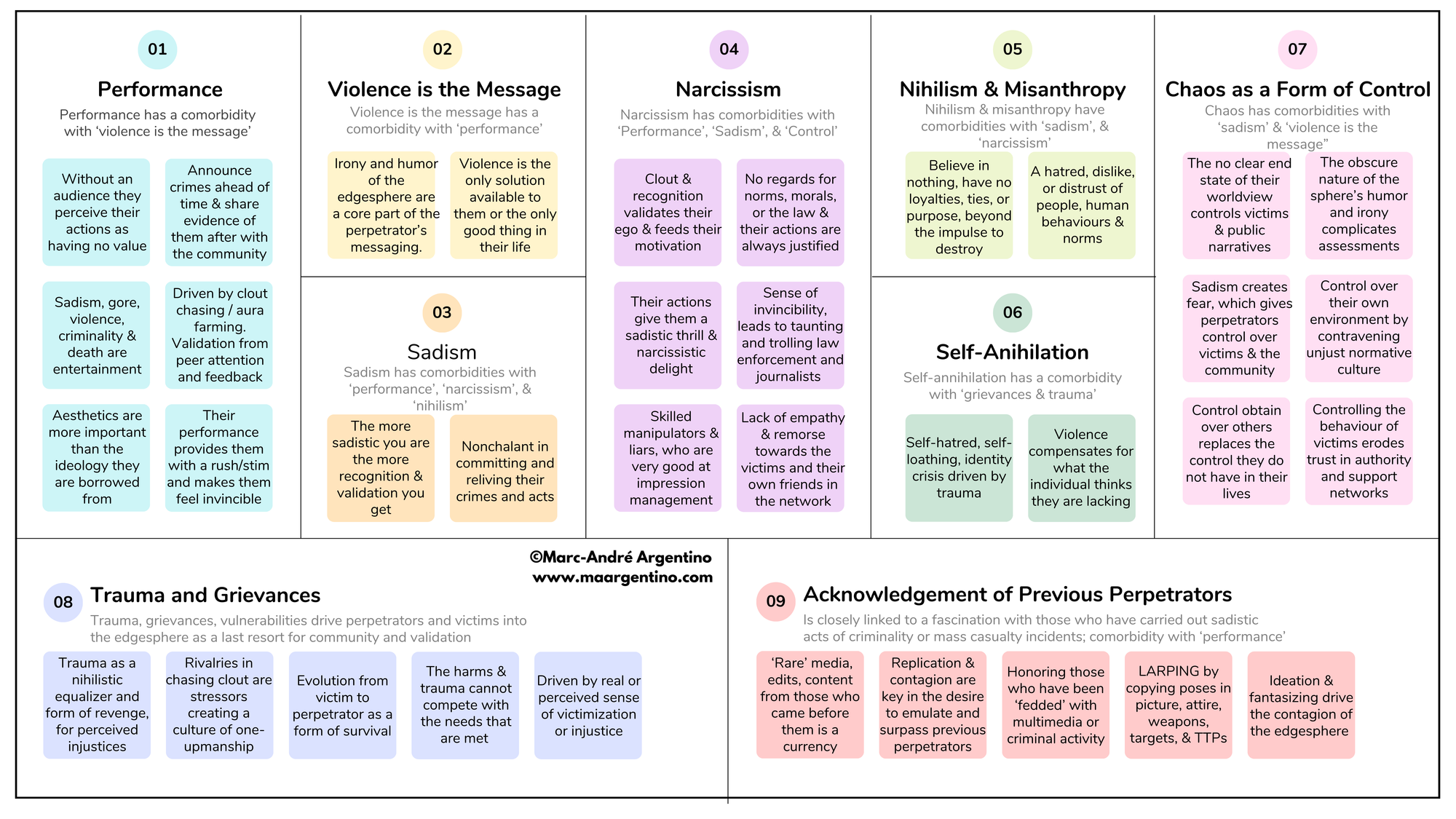
I still have not developed a scale or score that identifies which of these nine categories are strong or weak indicators of NVE; nor have I determined how many of these need to be present to have a confidence score to determine whether an individual or incident is NVE. There is also a need to flesh out the comorbidities between these categories and how they interact with each other. These categories, however, are the most common that I have identified so far in my preliminary research, and this is very much still experimental (remember, this is a blog and not a peer-reviewed journal).
1. Performance
Performance is the cornerstone of the NVE milieu, where actions hold little value without an audience. Perpetrators stage their violence as performative acts meant for peer recognition. Notoriety is achieved through spectacle rather than ideological argumentation. Within NVE milieus, sadism, gore, and aesthetics become forms of entertainment and drivers of humor and irony, while aesthetics borrowed from extremist or popular culture provide legitimacy through recognizability. Recognition and validation within these deviant peer groups establish hierarchy and influence. Thus, performance in NVE is not simply expressive but constitutive: it defines identity, sustains membership, and drives escalation.
2. Violence is the Message
In NVE spaces, violence itself is the communicative medium. Rather than promoting a coherent doctrine, perpetrators frame violence as the only meaningful statement available to them, echoing Baudrillard’s analyses of violence as spectacle. Humor and irony, characteristic of the “edgy” digital subcultures from which NVE emerges, further complicate interpretation by cloaking serious intent in absurdity. Violence here serves multiple functions: catharsis for personal grievances, symbolic capital for peer validation, and communicative disruption against societal norms. This blurs the distinction between tactical violence and expressive violence, producing acts where the primary goal is circulation and recognition rather than strategic effect.
3. Sadism
Sadism operates as a reward mechanism within NVE. The greater the cruelty displayed, the more recognition participants receive, creating a feedback loop that incentivizes ever more transgressive behavior. Perpetrators exhibit a striking nonchalance toward violence, often reliving and circulating recordings of their own acts. This resonates with “cruel play” and sadistic delinquency, where harm is pursued for its own sake rather than for instrumental ends. Sadism also reflects a key comorbidity: it feeds narcissistic self-image, reinforces performative displays, and aligns with nihilistic disdain for human life. Within the NVE ecosystem, sadism is not an aberration but a central axis of social currency and status competition.
4. Narcissism
Narcissistic traits permeate NVE participation, where clout and recognition validate fragile egos, reinforce the sense of entitlement and provide sadistic delight. Members justify their actions as always warranted, exhibiting disregard for law, morality, or social norms. Lack of empathy and manipulative skill facilitate transgressive behavior. Within digital subcultures, narcissism manifests through impression management: trolling law enforcement, journalists, or peers to demonstrate control and superiority. The sense of invincibility cultivated by peer validation fuels further escalation, situating narcissism as both an individual psychological trait and a structural feature of the networked environment.
5. Nihilism and Misanthropy
NVE is grounded less in coherent doctrines than in a nihilistic rejection of meaning and a misanthropic disdain for humanity. Participants profess belief in “nothing” beyond the impulse to destroy. Misanthropy manifests as a generalized hatred or distrust of people, norms, and institutions, which provides a veneer of justification for acts of cruelty. Unlike ideologically motivated extremism, where violence is framed as a means to a utopic end, NVE embraces destruction as an end in itself. This nihilistic worldview legitimizes violence while hollowing out possibilities for counter-narratives grounded in ideology, since there is no positive project to contest.
6. Self-Annihilation
Self-annihilation underscores the degree to which NVE is as much inwardly destructive as outwardly violent. Participants often express self-hatred, loathing, or crises of identity driven by trauma, turning to violence as a compensatory mechanism. This aligns with theories linking suicidality and mass violence, where external aggression is entangled with self-destruction. Within NVE, harming others becomes a form of self-expression rooted in despair and fatalism. Violence provides temporary relief from perceived emptiness, reinforcing cycles of self-destruction that blur distinctions between victimhood and perpetration. This dynamic complicates prevention, as interventions must address both externalized aggression and internalized self-destructive impulses.
7. Chaos as a Form of Control
Chaos functions as both strategy and affect within NVE. By cultivating ambiguity, irony, and unpredictability, perpetrators make it difficult for authorities, front line practitioners, and even peers to assess intent. This obscurity undermines trust in authority and destabilizes public narratives, amplifying the cultural impact of even minor acts. Control over others (whether victims, peers, or audiences) is achieved by violating social norms and generating fear, effectively replacing the control lacking in perpetrators’ personal lives. What comes out is deviance as empowerment, where chaos is leveraged to invert traditional hierarchies of authority. Within NVE, chaos is not simply collateral, it is the intended outcome.
8. Trauma and Grievances
Trauma, grievances, and vulnerabilities provide fertile ground for recruitment and persistence in NVE spaces. Participants often enter these milieus driven by personal victimization, perceived injustices, or unresolved trauma. Over time, the identity of “victim” evolves into that of “perpetrator,” framed as survival in a hostile world. Rivalries over clout exacerbate these grievances, creating a culture of one-upmanship where harm is both coping mechanism and competitive act. Ultimately, unaddressed trauma fosters cycles of violence. Importantly, in NVE ecosystems the trauma & harms caused by the community are outweighed by the needs that the community fulfills, making trauma and grievances both an entry point and a sustaining force.
9. Acknowledgement of Previous Perpetrators
The glorification of past perpetrators cements continuity within the NVE milieu. Media, edits, and archives of previous acts are treated as cultural currency, while replication and contagion are central to status-seeking. Copycat behavior, whether posing with weapons, mimicking aesthetics, or re-enacting tactics, blurs the line between fantasy and enactment. This process is not only commemorative but competitive: participants aim to emulate and surpass their predecessors. In NVE milieus, past actors function as both benchmarks and role models, ensuring the subculture reproduces itself across networks and time.
Taken together, these nine categories highlight Nihilistic Violent Extremism as a worldview where recognition, spectacle, and negation override ideological coherence. Each driver reinforces the others: performance depends on violence; sadism intensifies narcissism; chaos reaffirms control; grievances provide entry points; and previous perpetrators guarantee cultural reproduction. This mutually reinforcing structure produces a self-sustaining mélange that escalates in severity and resists disruption by conventional counter-extremism strategies. Unlike traditional extremism rooted in doctrine, NVE represents a “nihilistic convergence” where destruction, recognition, and trauma form the central logic of participation.