The (Unironic) Jewish Nationalist Nazi Teens Taking Inspiration from Mass Killers

Content Warning: Hate speech, hateful and violent imagery, discussion of targeted and mass violence
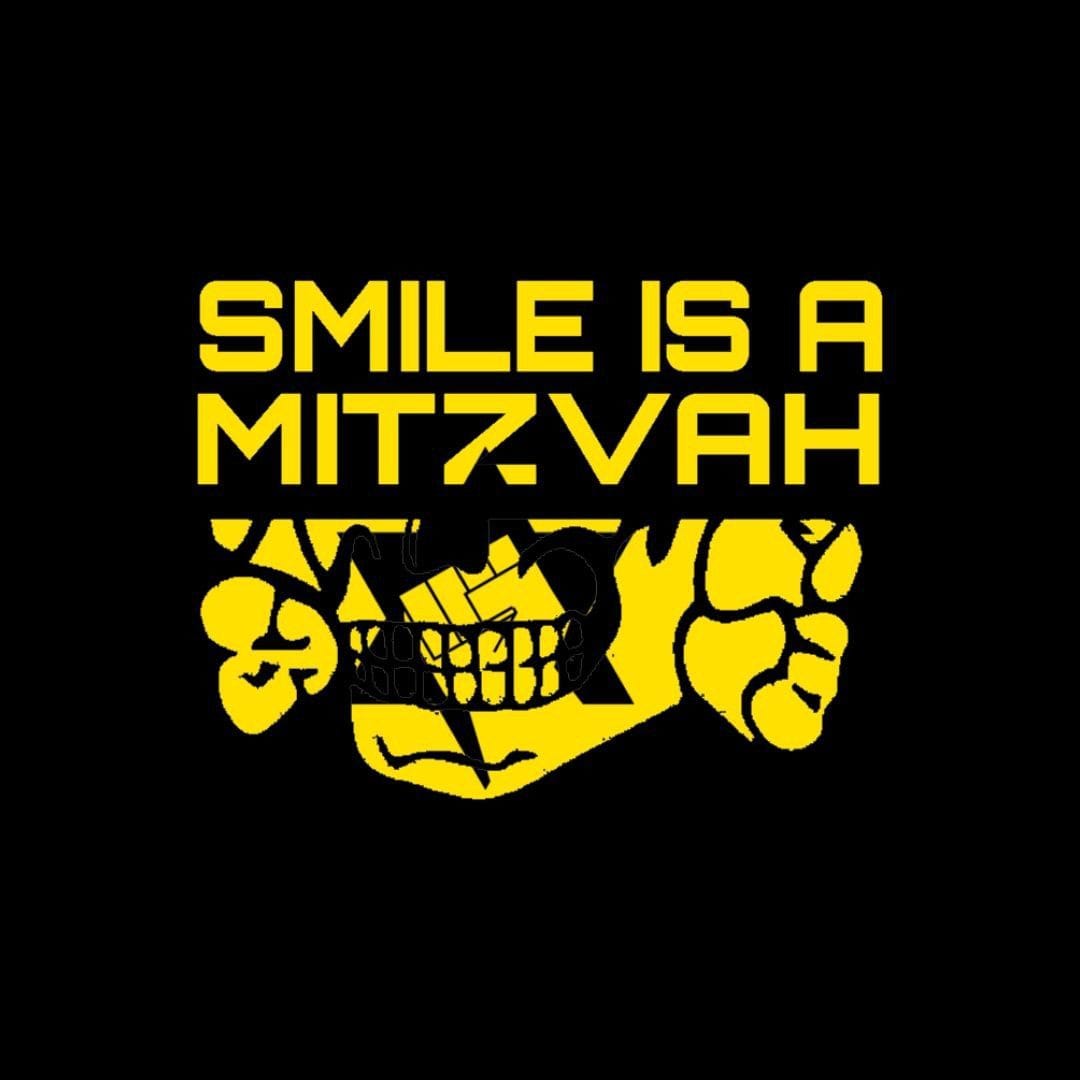
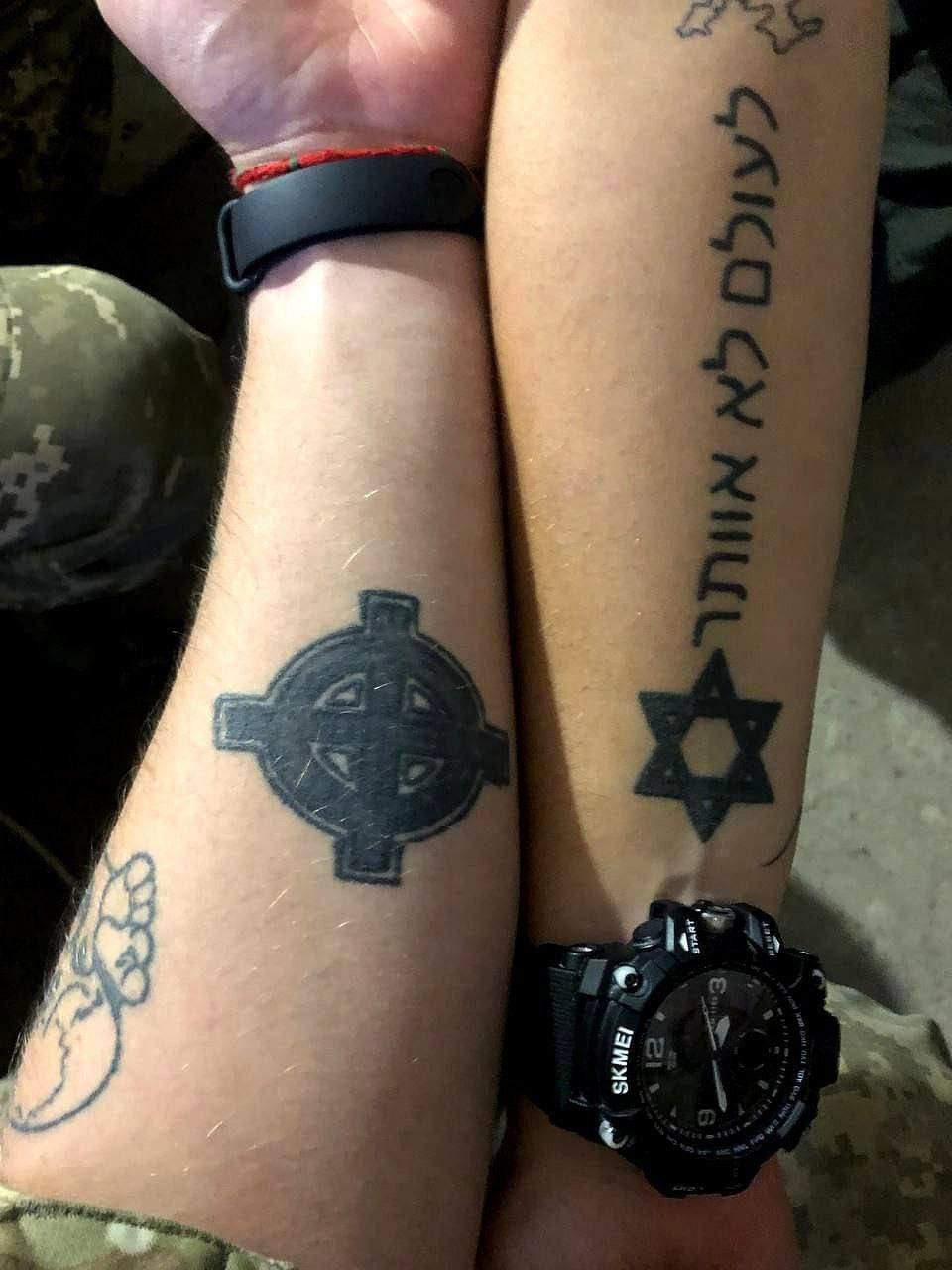
Left: An illustration of the bottom half of the Third SS Panzer Division insignia-a smiling Totenkopf-imposed with the flag of the Jewish Defense League. A Mitzvah is Jewish task which (very) roughly translates to a good deed. Retrieved from Tiktok. Right: Two arms cross to compare their tattoos: a Third Waffen Division Totenkopf and a Neo-Nazi Crosshair or Celtic Cross on one, a Star of David and Hebrew text on the other. Retrieved from Telegram.
It opens much like any other video in the genre. Hard techno bass beats play over spinning meme characters. Absolutely everything on screen flashes brightly. Skull masks are edited over existing faces. A spinning, flashing Black Sun symbol makes way for flashing text on screen “Don’t be cucked.” Bloody videos of street beatings and people maimed, bleeding on the streets, and buildings blown up by bombs. Flashing messages appear on screen encouraging ethnic division and calling for mass violence: “You don’t want to live with them,” “kill Palestinian children…” “Strike their buildings.”
It has all of the staples of a video you might see on Terrorgram, the Nazi terrorism propaganda collective that descended from 2010s neo-Nazi groups which now sets the standards for such videos. But the Black Sun’s have Stars of David in them. The man in the skullmask is not a Nazi, but a Jewish nationalist. The final call to action doesn’t address white men, but those “chosen by god [sic] himself.”
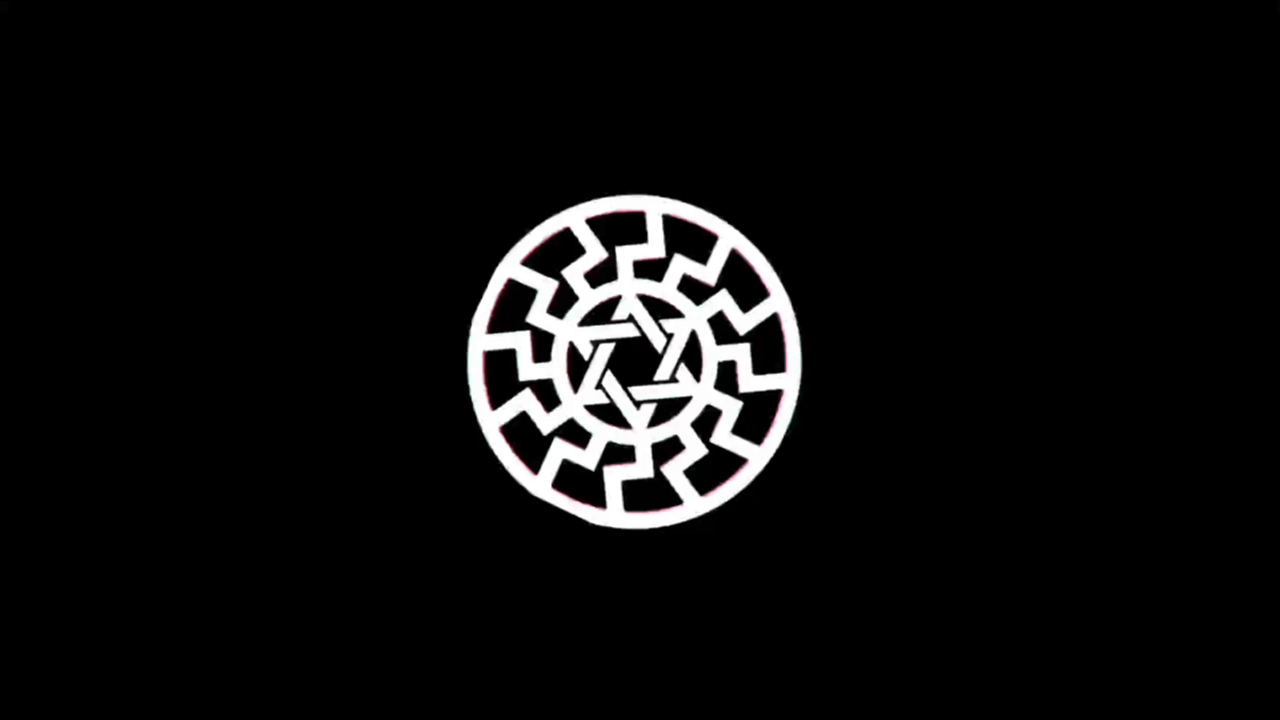
The video, which I have now seen appear in multiple places is a product of a transnational online community of Jewish youth celebrating neo-Nazism, extreme Jewish nationalism, and terrorism in the name of both movements. Though the community is largely ostracized by adjacent Nazis on Tiktok, and rife with contradictions itself, it has reached internet virility and integrated itself into a larger community of neo-Nazi accelerationists with some degree of success. The community’s top social media accounts have amassed hundreds of followers, and its top influencers effectively adapt to emerging trends in neo-Nazi accelerationism, overcoming extreme antisemitism with rabid displays of Islamophobia, anti-2SLGBTQI+ sentiments, and violent inclinations as they grow.
While neofascist Jewish nationalist movements are not novel, this emerging movement places Jewish right-wing extremists in the intersection of ideological and strategic developments which have previously not been compatible with open Jewish identity. This is depicted clearly, and often with complete self-awareness in the movement’s considerably large volume of propaganda. Yalmulkes and skull masks worn together; depictions of Stars of David inside of Swastikas and Wewelsburg “Black Sun” motifs; Jewish caricatures imposed onto the smiling skull insignia used by Nazi Germany’s SS; fan montages of neo-Nazis and Kahanist terrorists; and Atomwaffen Division fonts and poster formats over brutal, bloody photographs of dead Palestinians are all commonplace in chatrooms and on social media pages.
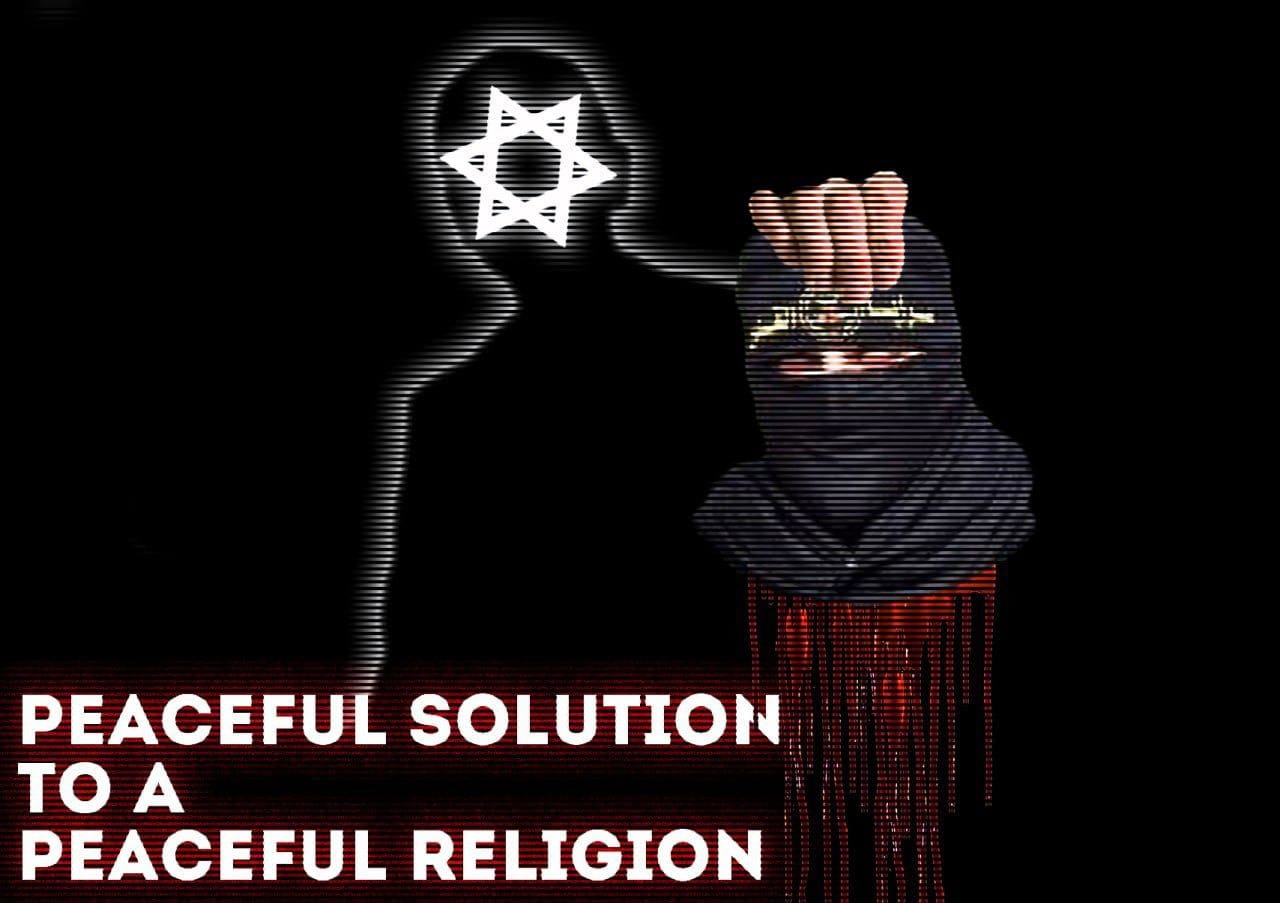
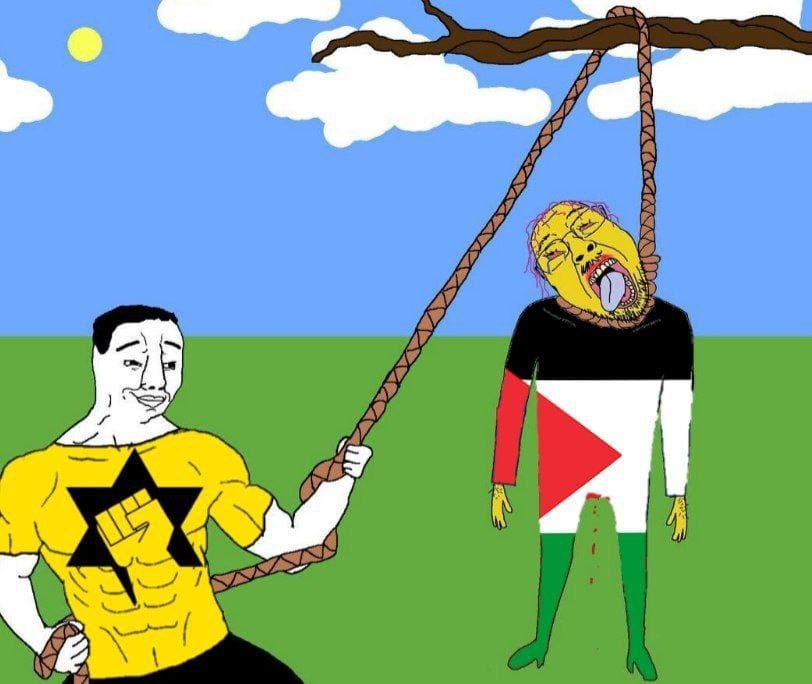
Left: A violent meme sarcastically referring to Islam as a “peaceful religion.” Right: A buff man in a Jewish Defense League t-shirt smiles as he kills a Palestine-flag laden caricature of a trans woman. Retrieved from Telegram.
While varying combinations of the words “Ashkenazi” and “Nazi” are sometimes used as self-descriptors in this movement, it would give an impression that Ashkenazi identity is central to the belief system. However, Mizrai Jews are also memed in positive connotations, depicted as conquerors and warriors in land historically inhabited only by them and Muslim ethnic groups (typically depicted as a single homogeneous people with savage and primitive traits). For lack of a better word, I’ll refer to the movement by the imperfect term Kahanazis in this article.
The term combines the only two aesthetic consistencies in this network, however inconsistent with each other they may actually be: Nazism, a distinct version of Fascism pioneered by Adolf Hitler which traditionally necessitates antisemitism; and Kahanism, an extremist Israeli nationalist ideology whose most notable adherents espouse Islamophobic, anti-Palestinian rhetoric and violence. The Jewish Defense League (JDL) is the best recognized Kahanist group in the US and Canada.
While their influence was undoubtedly in decline, some dormant JDL chapters have reignited in 2024 to capitalize on the October 7, 2023 Hamas attacks in Israel and the ensuing Israeli military occupation of Palestine, which human rights experts, advocacy groups, and genocide scholars consider to be part of an ongoing genocide towards the Palestinian people.
Though it shouldn’t need to be said: Nazis hate Jews, and the Kahanists typically hate Nazis. Historic JDL leader Irv Rubin, a Canadian born in Montreal, was charged with both orchestrating bomb plots against Arab-Americans and offering cash rewards for killing or maiming neo-Nazis.
However impractical and incoherent it may seem, Kahanazis admire both the JDL and neo-Nazi groups.
Ideology, Culture, and Lack Thereof
Though the movement is loaded with contradictions and poor ideological consistency, followers typically display a consistent adoration of Kahanism, the Jewish Defense League, and hatred towards 2LSGBTQIA+ people, Muslims, Arabs, and Palestinians.
Followers sometimes promote the legacy of Avraham Stern, an Polish Jewish nationalist who unsuccessfully tried to form an agreement with Nazi Germany during the Holocaust. Stern tried proposing to Germany that Jews could be relocated from Europe to British-occupied Palestine in 1941, a time when Nazis were systematically eradicating Jews in slavery and extermination camps (and had no interest in relocating Jewish people). He rejected Palestinian independence and British occupation led Jewish nationalist militant efforts to fight British forces in Palestine. In Kahanazi memes, Stern is sometimes depicted as an ethnonationalist visionary, pioneering a racially-segregated future for Israel and Palestine which could compliment Hitler’s vision for Germany.
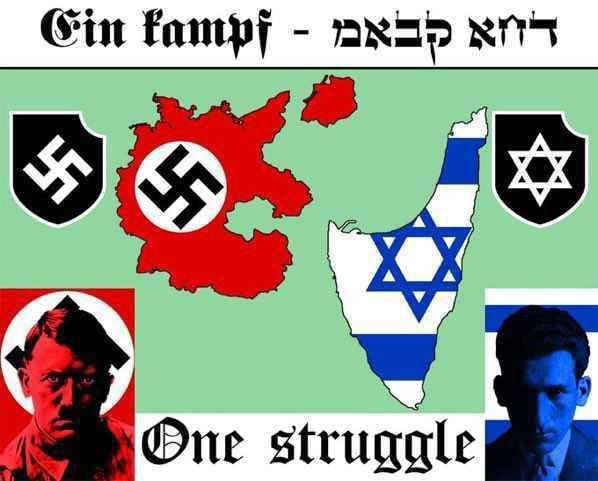
Celebration of Nazi Germany and neo-Nazi culture and accomplishments are secondary but common, as is interest in Russian “Maniac” culture, National Socialist black metal, and accelerationist terrorism. Interest and promotional references to nihilistic violent extremists and the Com Network–a decentralized online network of teenagers and young adult groups dedicated to cybercrime, blackmail, extortion, child sexual abuse, and violent extremism–and the antisemitic neo-Nazi occult religion Order of Nine Angles are apparent (though these appear mostly aesthetic, not ideological). In public photographs and videos, members wear jewelry depicting Stars of David, Jewish Defense League merchandise, and white power merchandise. Branding of the Azov Regiment (a part of the Ukrainian national guard which originated as a white supremacist civilian battalion) and М8Л8ТХ (Also spelled as M8L8TH)--a Russian neo-Nazi metal band living in Ukraine whose singer associates with the Azov Regiment–are particular common.
While it’s easy to shrug off a proudly Jewish form of neo-Nazism as nonsensical, it is worth noting that the attraction to this intersection–while rare–is not a one-off instance. While many social media accounts in this network could be run by a small number of actors, open-source analysis indicates that many are real people, with evidence of legitimate Jewish roots in their personal background. While the significance of (and dedication to) the emerging culture is already evident, this observation can also be determined by the intersections between online and offline activity. Some have taken to in-person demonstrations, wearing skullmasks (a popular token of neo-Nazi accelerationism popularized by groups like the Atomwaffen Division) with yalkmulkes, tefillin, and symbols of the Kahan Chai to counter pro-Palestine protesters. Others post their real faces (most often Ashkenazi young men and teenage boys, some of whom look barely old enough to be bar mitzvah’ed) with similar personal tokens of their adherence to the movement. Images of logos and even photographs of plate carrier patches depicting Jewish nationalist and Israeli nationalist twists on international far-right insignias are shared.
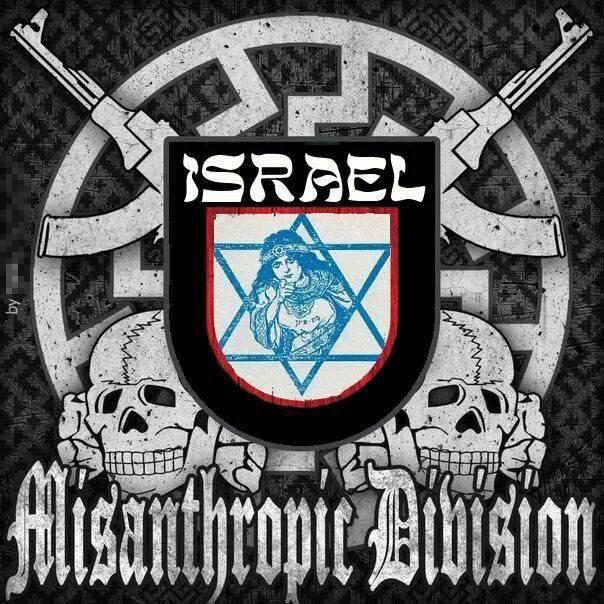
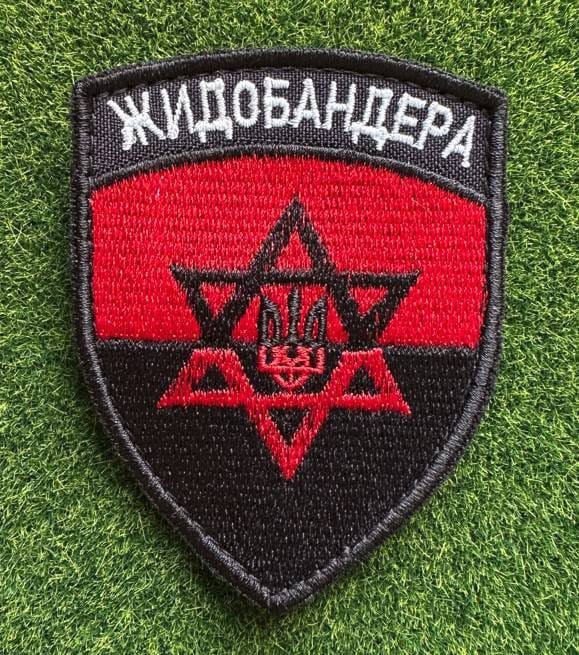
Left: poster promoting a supposed Israel chapter or branch of the Misanthropic Division, a Ukraine-based neo-Nazi group with international presence (including in Canada). Right: A Ukrainian trident and a Jewish Star of David in a Banderite insignia. (Banderism’s namesake, Stephen Bandera, was a Nazi Germany collaborator and an antisemite). Retrieved from Telegram.
The movement especially reveres American-Israeli terrorist Baruch Goldstein, a Kahanist terrorist who murdered 29 Muslims in a West Bank Mosque on Ramadan. Fan content depicts Goldstein in the same light as Nazi militant accelerationists, following the culture of adoration demonstrated by Nazi accelerationists’ pantheon of “Saints” (white supremacist and adjacent extremists revered for killing people in the name of their cause). Goldstein is depicted repeatedly in favorable memes alongside Christchurch Mosque shooter Brenton Tarrant, even though Goldstein was a devout Jewish nationalist and Brenton Tarrant was an antisemitic neo-Nazi.
![Poorly cropped dancing man in front of an AI generated place resembling a colourful Mosque. Text in front reads "-29 [Star and Crescent] [laughing face]."](https://www.maargentino.com/content/images/2025/10/data-src-image-450ebd66-5fe6-4aed-bf46-05b0ac7b7b4a.png)
Where the ideology is especially incoherent, the conversation is dictated by a show of clout. In other words, what the movement may lack in in-group traits of the global far-right, there’s a point at which the young Jewish men involved try to make up for it with the quality or quantity of their posts, their memes, and their edge. Graphic war footage, gore videos, senseless violence, and dehumanizing rhetoric–especially towards Palestinians–are all intertwined with Kahanist and Nazi imagery, and much more commonplace than any discussion of ideology, tactics, or strategy.
At times, accounts identifying as part of the movement post content which includes Order of Nine Angles (O9A) iconography and even increasingly promotes Maniac Murder Cult, a neo-Nazi and nihilistic violent extremist group influenced by Maniac culture, serial killer and spree killer fandom, and Nazi skinhead culture. Through their success at filming and distributing video footage of their beatings, stabbings, and killings of strangers, MKY has become wildly popular among all of the aforementioned online milieus, and is sometimes credited with popularizing Maniac culture among western white supremacists and nihilistic violent extremists. The group’s infamy expanded considerably when its second leader, Georgian national Mikael Chkhikvishvili, was indicted for planning a mass casualty attack in which he would dress up as Santa Claus and hand out deadly poisoned candy to Jewish and racialized children in New York. (Chkhikvishvili was working in New York at the time as a caretaker to a dying elderly Jewish man who he boasted about torturing, according to the indictment against him.) Kahanazis use of Maniac aesthetics and interest in M8L8TH is consistent with MKY. (MKY founder Yegor Krasnov is a M8L8TH fan, and is often depicted in fan art with his M8L8TH t-shirt.)
The presence of O9A iconography is especially unique for Jewish far-right actors. While limited Nexions (an in-group term for a sect of the O9A) have included racialized and queer people, ethnically Jewish adherents to the Order of Nine Angles are few and far between. Religious Jews are plainly non-existent in the O9A, as the religion of the O9A explicitly places Jews within the role of spiritual and cosmic enemies to the Aryan race. In contrast, Kahanazis are typically religious or present themselves to some degree, with followers of the movement representing themselves with yalmulkes and wrapped in tefillin (a Jewish tradition for men in prayer).
Comparisons to Contemporary Racialized Neo-Nazi Movements
The Kahanazi movement is likely rooted in what journalist Ben Lorder coined “Bronze Age Zionists.” (Lorber explains the movement clearly in this exceptionally enlightening article for Religion Dispatches.) The movements overlap significantly, both in their ideological and aesthetic elements This is especially clear in the ways in which they depict historic Jewish identity and their shared hate of Muslims, Arabs, and queer people. Social media meme accounts (notably on Tiktok) from this movement and Kahanazis interact with each other often. Although they share much more ideology in common, I would still argue that there are limited distinctions in how activists appear to operate. Kahanazis are significantly more engaged with neo-Nazi accelerationism and an adoration of antisemitic figures, including Adolf Hitler.
While no significant white nationalist movement has come from Bronze Age Zionists or the Jewish nationalist Nazis which inhabit the same spaces, there are limited notable Jewish activists in white nationalist movements. It would be a natural step in analyzing these networks to compare them to some of the more notable cases.
A first instinct would be to look to historic examples of Jewish Nazis. Frank Collin, perhaps the most high-profile legitimate Jewish Neo-Nazi, would seem at a glance to be a natural case study to compare to. (As a brief history lesson: Collin was a prominent member of the American Nazi Party in the 1960s and 1970s who long denied accusations of his Jewish roots from rival neo-Nazis.) Regrettably, Frank Collin’s story is not one that helps understand these particular Jewish Nazis today. Collin did not embrace his Jewish identity. He denied it, even going as far as publicly refuting his own father, a survivor of the Dashau death camp who went public with his biography. One could hypothesize Frank Collin’s Nazism was more about searching for an insular community that accepted unacceptable behaviours than it was about ideology: He was later convicted of child molestation, and became involved in New Age beliefs after his prison term.
Throughout the 2010s, there have been some Jewish allies to the alt-right. The most prominent of these is probably Laura Loomer, a Jewish promoter of white nationalism who has been rumoured to advise the White House and spend time with the current US president. Despite Loomer’s heritage, she is deeply involved with the explicitly antisemitic white nationalist Groyper movement, and is closely affiliated with vocal Holocaust deniers and Nazi Germany sympathizers like Nick Fuentes, Amrou “Myron Gaines” Foudl, and Kanye West. However, Loomer takes on more of a useful token identity as a Jewish person in the movement. Loomer has amicable disagreements with her peers over whether or not Jews fabricated the Holocaust (Loomer believes it did occur, but has suggested in ridiculous fashion that Black Lives Matter would enact a second Holocaust), and expresses no exterminatory rhetoric towards Jews.
Ron Unz–an ethnically Jewish Holocaust denier, financier, and publisher of neo-Nazi content is an exception to this, having embraced the neo-Nazi elements of the alt-right. However, Unz’ espouses no Jewish nationalism, unlike the Bronze Age Zionists or Kahanazis. Instead, Unz seems to rely on his background as a point of authority to allow the appearance of inside knowledge, or else glosses over it completely when addressing his target audience. Furthermore, Unz’ strategy emphasizes publishing, funding, podcasting, and political networking, not terrorism.
In contrast, the Kahanazis’ consistent celebration and outright promotion of accelerationist neo-Nazism and use of content from groups like MKY sets its identity apart from Jewish exceptions in white nationalism. It does not merely endorse a theoretical broad, Jewish-inclusive unity among antisemitic far-right networks. It embraces anti-state terrorism, mass violence, and openly genocidal movements and tactics. Alliances with Holocaust deniers and Nazi Germany sympathizers who may flirt with, or even outright promote, a second Holocaust in a hypothesized, hopeful future are passé. Instead, Kahanazis seek to prove their adherence to only the most extreme, immediate solutions to the existence of groups of people not as a political goal, not through policy, but through adapting shocking violence as soon as possible.
Jewish Nazis are not the first marginalized group to adopt these violent tactics in the hopes of forming a post-collapse ethnostate which wouldn’t allow them their own freedom. (For some notable examples, I’d recommend the article Nazis of Color by Spencer Sunshine and Isaac in Unicorn Riot.) From the formative years of modern Siege culture on Iron March, the movement has included people targeted by it. A recent high-profile example is Solomon Henderson, a Black neo-Nazi and nihilistic violent extremist who committed a deadly shooting at his high school in Nashville earlier this year. Like some Kahanazis, Henderson was fascinated with mass violence and expressed interest in MKY. He was also involved in school shooter fan networks which demonstrated ideological adherence to the Terrorgram collective.
Unlike Kahanazis, Henderson embraced white supremacist stereotypes of his own identity literally, misanthropically, and without countering this outlook with any secondary ethnonationalist schools of thought. He expressed extreme self-loathing, arguing in his manifesto that he was bettering the world by killing himself so that one less Black person would exist in the world.
On a macro-scale, Kahanazis could also be compared to Eastern neo-Nazi movements, as many of these movements have had historic success at cohesively adopting Nazism to nonwhite identity. This can be observed between multiple Nazi movements in South and Southeast Asia which identify and degrade specific out-groups, not unlike Kahanazis tend to single out overlapping Arab Muslims. In India and Singapore, this has meant targeting Muslims. In Mongolia: ethnic and national Chinese populations.
Strategies and Offline Action
Typically, the strategy of Kahanazi actors has focused on creating propaganda, debating with other far-right extremists, and eventually convincing young Jewish boys and men to engage with it. This is done through polishing modern propaganda. The approach is largely visual, focusing on memes and terrorwave videos, sometimes including footage of gore and dead Palestinians. Of these videos, the less overtly hateful and violent ones are spread on Tiktok. There, they elicite controversy and engagement from mortified onlookers; perplexed reactions from pro-Israel right-wing accounts; and rebukes from neo-Nazis–keen to angrily defend their cultural pastime of editing gore footage to bad electronic music from those they see as subversive Jewish interlopers. Via Tiktoks and direct messages, sympathetic and curious users are directed to Telegram chats where more extreme materials are shared.
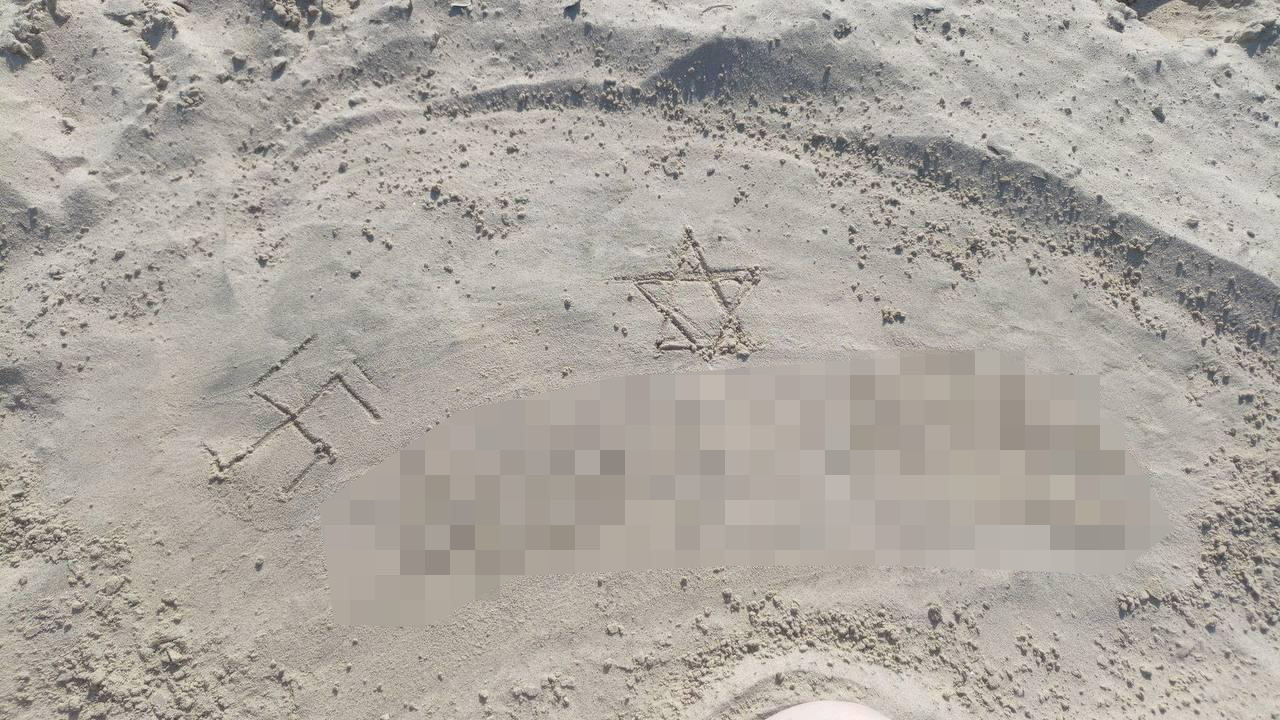
While the activity of the Kahanazi movement is undoubtedly an online network invested primarily in memetic warfare, there are hints that the network is ready for offline action. Members of the network frequently post videos of themselves posing with Jewish Defense League merchandise, disrupting pro-Palestine demonstrations, and taking their irony-poisoned brand of meming to offline tagging.
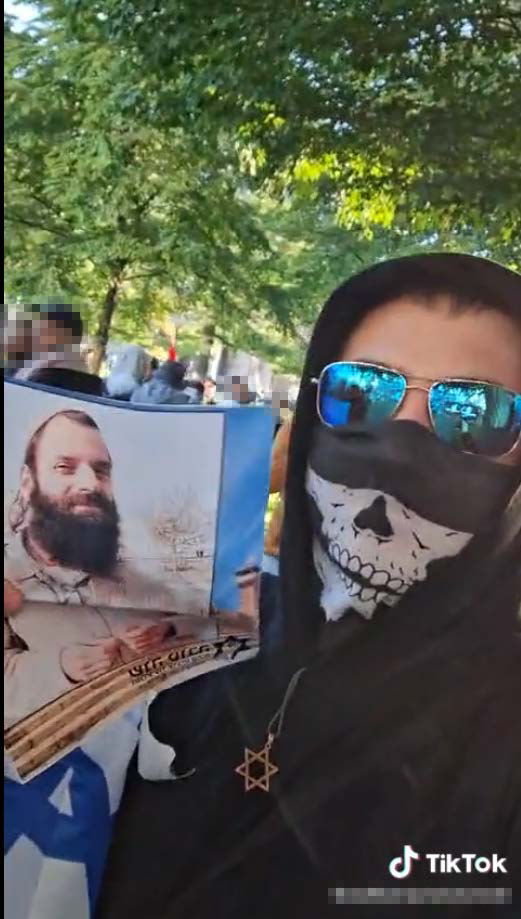
In one particularly alarming case, a Canadian teenager adorned in a skull mask posed in front of pro-Palestine demonstrators in the streets of Toronto with a printed out poster of Baruch Goldstein.
Conclusions
With a lack of ideological cohesion and a very, very limited identity to appeal to (Jewish Nazis are not exactly a major demographic), it is possible that this movement goes in a few different directions.
The first is that it becomes more cohesive: It may draw on more appealing far-right grievances among Jewish youth, or else desensitize young radical Zionists to neo-Nazism over continued online exposure.
Another is that the teenagers and young men engaged in the subculture find a home in more organized Kahanist movements, as some evidently already have. This would allow them to engage in offline activism, intimidation, and violent tendencies with more organizational capabilities, while still engaging openly in much of the same extreme violent and hateful rhetoric online and offline. And though they are rare, there are certainly violent Kahanists in North America. Toronto police arrested a man in February who was found with Kahane Chai paraphernalia. As online activity shows, the current Western political environment is rife with cross-movement hatred for Palestinians, leaving ample opportunity for Kahanist group resurgences in more unlikely cities.
Others may find homes in more violent, exploitative, and unpredictable nihilistic violent extremist groups. This would better appeal to fixations on violence while satisfying the unsophisticated (and mostly aesthetic) ideological leanings of teenagers venerating men like Baruch Goldstein and posting MKY content.
Evidently, all of these options are public safety and national security risks. With a movement so fascinated with violence for the sake of violence and such little room for ideological interference, there is no clear trajectory and no single solution. Short of reporting every Jewish teenager who venerates the Atomwaffen to their moms and their shuls, a multisectoral approach to mental health, youth well being, and social cohesion is more than likely going to be the only thing that insulates us.
An earlier version of this article misidentified former Alternative Right author Richard Hanania as Jewish. This was a misunderstanding of comments Hanania has made about Judaism and has since been deleted.